



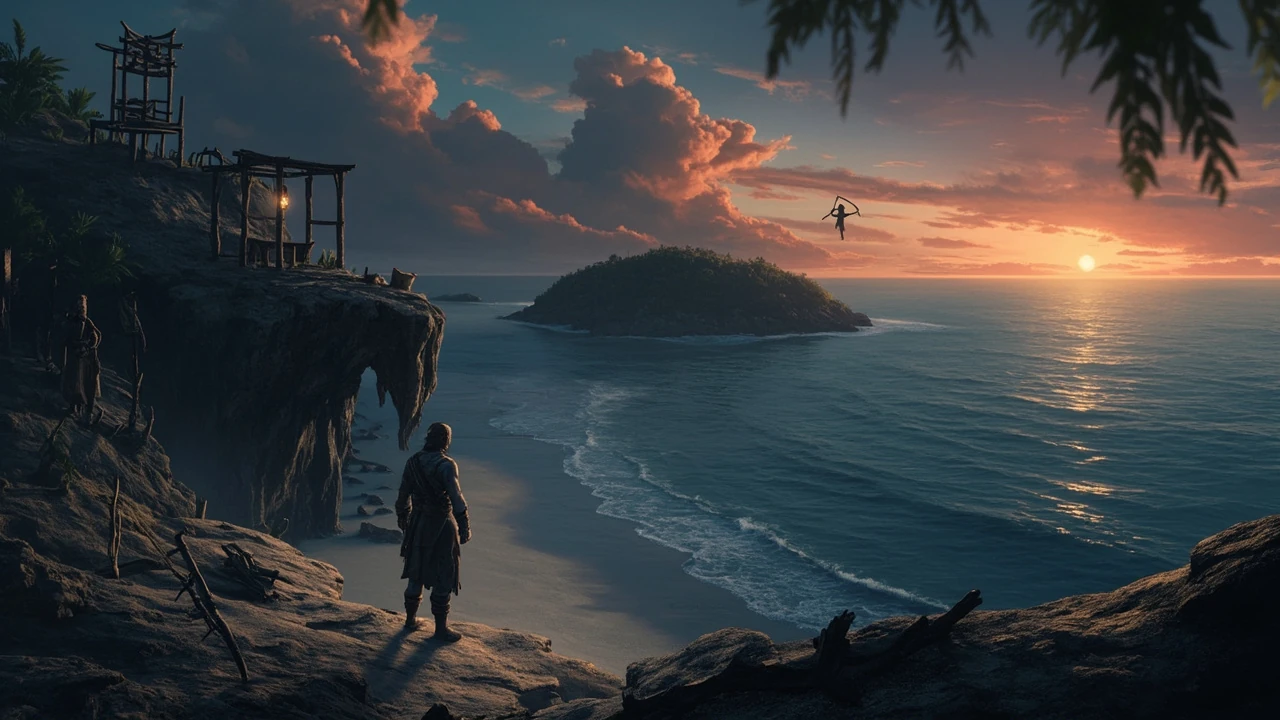

Link steps onto the sand at Eventide Island in BOTW and the rules change. Weapons, bows, and armor vanish from the inventory. Strips of cloth replace the usual tunic. The player keeps a sword, a wooden bow, and a bundle of arrows, then is told to reach the summit in about fifty minutes while a hidden monk hunts them with a bow and ancient arrows. What feels like a side diversion is, in design terms, a tightly scoped open-world trial that compresses many of Breath of the Wild’s core systems into a single location. Reading it as a case study is useful for developers because it shows how a large sandbox can hide a small, handcrafted encounter without breaking the sense of freedom.
This article treats Eventide Island in BOTW as a design artifact rather than a walkthrough. It looks at the rules the encounter imposes, the way the map is staged, the role of the monk, the way failure is handled, and what each of those choices says about pacing, risk, and player feedback. The aim is to give developers, designers, and level planners a usable mental model when they want to drop a focused challenge into an open world without relying on a loading screen or a quest flag wall.
Eventide Island in BOTW as a design case study
Eventide Island is a small island off the southeast coast of the Hateno region. Mechanically it is a shrine quest: completing the trial and reaching the top opens the hidden Ka’o Makaka shrine and rewards a Spirit Orb. As a piece of design it does three things at once. It resets the player’s equipment, isolates them on a single map, and forces a long uninterrupted sequence of combat, exploration, and platforming in a hostile environment. Each of those choices has consequences worth studying.
The first consequence is honesty about player skill. Most open-world encounters in BOTW can be out-leveled or out-geared. A player who prepares enough weapons and high-tier armor can flatten almost any challenge the overworld offers. Eventide Island in BOTW removes that lever. Because items are stripped at the start, the trial tests what the player knows about timing, stamina, elemental interactions, and resource use rather than how many Savage Lynel swords they have banked. From a design perspective this is a clean way to measure skill without inventing a separate difficulty setting.
The second consequence is spatial focus. The island is large enough to feel like a real place, with beaches, forests, ruins, cliffs, and a central peak, but small enough that the player can hold the whole map in their head. Every region is visible from a high vantage point within a few minutes of climbing. That visibility is intentional. Designers want the player to plan their route rather than wander, so they give them the information needed to plan. The contrast with the rest of the map, where long sight lines often hide a surprise, is part of the appeal.
The third consequence is the time limit. Roughly fifty minutes is enough for a careful player to complete the trial with margin to spare and tight enough that an indecisive player will feel pressure near the end. The clock is not a hard fail state; if the player does not reach the summit in time the monk will still try to kill them, but the encounter does not end the game. This is a softer rule than a typical timer, and it gives designers a useful template: impose urgency without enforcing it through a fail screen.
Why the equipment reset is the most important design choice
The equipment reset is the single most distinctive feature of Eventide Island in BOTW. The player is told not to bring weapons, and the game follows that instruction by stripping almost everything from the inventory. The sword, bow, and arrow bundle that remain are not a kindness. They are a teaching tool. They establish a baseline that scales only with what the player finds on the island, so every weapon upgrade is relative rather than absolute.
Relative scaling does three things for design. It forces the player to value the weapons they find, which raises the emotional weight of combat. It makes the environment itself a resource layer, because new weapons appear from defeated enemies, broken crates, and hidden chests. It also prevents the encounter from collapsing into a single trick. A player who tries to brute-force the trial with a single strong weapon will run out, because durability still applies. A player who experiments with bombs, magnesis, stasis, cryonis, and elemental arrows will find soft paths that the encounter quietly supports.
From a developer standpoint the reset is a load-bearing rule. Without it the trial would still be a fight, but it would not be a fair test of the player’s understanding of the systems. With it the trial becomes a small, self-contained exam on how Breath of the Wild actually plays. When designers want a similar effect in their own projects, the lesson is that stripping progression layers can reveal mechanics the rest of the game allows players to ignore.
Map staging and the rhythm of the climb
Eventide Island in BOTW is staged as a series of vertical tiers. The player lands on a southern beach, fights through low-lying ruins and bokoblin camps, climbs a forested slope, crosses a mid-level plateau with a Hinox, and finishes at the summit shrine. Each tier has its own threat profile, and the spacing between them gives the player a chance to breathe, search, and re-equip before the next step.
The vertical rhythm is a deliberate pacing tool. Open worlds often struggle with the gap between combat encounters; travel time can stretch until the player loses focus. By chaining encounters along a single climb, the encounter compresses that gap. The player is rarely more than a minute of climbing from the next fight, but each fight changes the environment slightly, which keeps the run feeling different even on repeated attempts.
The map also teaches through visibility. From the southern beach the player can see the Hinox plateau and the shrine tower on the summit. That visual promise of the end of the trial is what gives the timer its meaning. The player always knows what they are running toward, which keeps the timer as a pressure rather than a punishment. Designers working in similar sandboxes can borrow this idea: when a timed segment has a clear visible goal, the time itself reads as drama instead of frustration.
Threat layering: enemies, environment, and the hidden monk
Eventide Island in BOTW layers three threat systems on top of the basic combat loop. The first is the population of standard enemies, including bokoblins, moblins, a Hinox, and a few keese. These enemies scale with the player’s underlying progress, so a player who has cleared a few divine beasts will still face tougher variants than a brand-new save. The second is environmental threat: rain that makes climbing risky, water that erodes weapon durability in lightning storms, and narrow cliff paths where one wrong step means respawning near the start. The third is the monk, who appears once the timer nears its end and hunts the player with a bow and ancient arrows.
The threat layers are designed to interact. Enemies can be used to thin each other out by detonating barrels or using fire arrows in dry grass. Weather can be weaponized to bring metal weapons into contact with lightning, which kills both the player and nearby enemies. The monk can be avoided by hugging the cliff walls, by stasis on his arrows, or by reaching the shrine door before he lands the killing shot. Each layer can be solved with at least one system the player has already learned elsewhere in the game. Nothing on Eventide Island requires a trick that the rest of the map has not already hinted at.
This is where the design reads as a cumulative test. Eventide Island in BOTW is not asking the player to learn new mechanics. It is asking them to apply the ones they already have, under pressure, with fewer resources. Designers can use that pattern whenever they want a late-game test that does not require late-game content: take the mechanics the player should already know, restrict the tools they would normally lean on, and force a clean application of the fundamentals.
The monk encounter as a soft timer and a tension valve
The monk, known as the “Monk’s Wish” in the in-game prompt, is the encounter’s most discussed design element. He is invisible until the player approaches the summit. He has a large health pool and fires ancient arrows that can one-shot Link if the player is not prepared. He exists for two reasons. The first is to make the timer feel real; if the player dawdles, a real enemy starts hunting them. The second is to give players who rush a punishment for ignoring the rest of the island, because the monk can spawn near them once they near the summit.
The monk is not a traditional boss. He is a force that converts time pressure into a live threat. Players have several ways to handle him. The first is to simply outrun him and reach the shrine door, which is the intended approach for most builds. The second is to use stasis on his arrows and then counterattack while he reloads. The third is to use the environment, hiding behind walls or using cryonis to block his line of sight. None of these strategies are obvious, but all of them are supported by systems the player has used elsewhere.
For developers, the monk design is a useful case in how to scale difficulty without inflating numbers. Eventide Island in BOTW could have made the final encounter a Lynel or a guardian and called it harder. Instead it introduced a single new enemy with a clear and limited behavior. The difficulty comes from the situation, not from raw stats. The lesson is that a small, well-placed enemy can do more work than a tougher one, especially when the situation itself is already tense.
Resource pacing, durability, and the soft economy of the trial
Eventide Island in BOTW is also a study in resource pacing. The player starts with limited tools and a small inventory. Weapons break, arrows run out, and shields degrade. The island replenishes those resources in two main ways: from enemy drops and from a small number of hidden chests, including one in a hollow tree and one underwater near a rock formation. The pacing of those resources is set so that a careful player can keep a small kit topped up, while a careless player will spend most of the trial near empty.
The soft economy is what makes the encounter feel like survival rather than combat. Weapons become more about throughput than power: players will often pick up a weak weapon simply because they need something in their hand. Elemental weapons and bomb arrows become disproportionately valuable because they interact with multiple enemy types. The shrine chest at the end of the trial restores the player’s inventory, which removes the lasting cost of the encounter and reinforces the idea that Eventide Island is a contained experience.
From a design standpoint the trial demonstrates how a limited economy can be used as a teaching tool. By giving the player just enough resources to finish if they manage them well, the encounter trains the player in the rest of the game to be more careful with weapon durability and arrow counts. Designers can borrow that structure in any game that uses a degrading resource layer: a short, contained run with tight supplies and a clear goal is often a more effective tutorial than a long speech. Readers who want more background on The Legend of Zelda can use the Legend of Zelda while reviewing this point.
Eventide Island sits within a much longer design conversation about the series and about open-world games more broadly. Other entries in the franchise build on similar ideas, and the wider design community has published thoughtful pieces on the construction of Breath of the Wild as a whole. The general history of the franchise, from the original NES release to the modern open-world entries, is documented in the Wikipedia entry for the series, which provides useful background for designers who want to trace how encounters like this one evolved. For focused analysis of any single encounter, however, time on the island remains more useful than any secondary source.
What Eventide Island teaches about open-world challenge placement
Open-world games often struggle with how to place difficult content. A clearly marked dungeon breaks the sense of freedom. A hidden boss with no lead-up feels unfair. Eventide Island in BOTW threads this needle by being optional, signposted by a statue, and clearly different from the surrounding map. The player is told by an NPC on the dock that the island is a trial, and the equipment stripping is a visual and mechanical cue that this is a special space.
The placement is also honest. The statue is on a beach, the island is small and isolated, and the shrine reward is a Spirit Orb, which the player already knows how to spend. There is no surprise about the stakes, only about the execution. That honesty is what lets the encounter coexist with the freedom of the overworld. A player who chooses to ignore the island misses a Spirit Orb but loses nothing critical. A player who chooses to engage gets a concentrated test of the skills they have been building all game.
Designers building open worlds can take the model of Eventide Island in BOTW as a pattern for any “boss rush” or “skill check” content. The recipe is straightforward: a clearly distinct location, an obvious invitation, a rule change that resets the player’s progression, an internal progression path that escalates, a soft timer or external pressure that keeps the pace up, and a clear reward tied to the existing progression system. None of those elements are unique to Breath of the Wild, but the way the encounter combines them is unusually clean.
Comparison: Eventide Island and the major trials in BOTW
Eventide Island is not the only major trial in the game. The three “Medoh, Rudania, and Ruta” divine beast quests, the labyrinths, the Spring of Courage, and the Master Trials all use similar ingredients in different proportions. Comparing them shows what Eventide Island does differently and why the design is worth studying on its own.
| Encounter | Equipment reset | Time pressure | Map focus | Main mechanic taught |
|---|---|---|---|---|
| Eventide Island in BOTW | Yes, near-total strip | Soft, around fifty minutes | Single island, fully visible | Application of all core systems under constraint |
| Vah Ruta divine beast | No, full inventory | None, until terminal phase | Single moving interior dungeon | Map ability combined with map reading |
| Lomei Labyrinths | No, full inventory | None | Single large maze interior | Navigation, combat in tight space |
| Master Trials (Beginning) | Yes, full strip | None | Sequence of small rooms | Combat in escalating waves |
| Spring of Courage shrine quest | No, full inventory | None | Short open area with one shrine | Recognition of hidden shrine |
The table makes the design space clearer. Eventide Island in BOTW combines two of the most distinctive ingredients, equipment reset and time pressure, in a single open environment. The Master Trials share the equipment reset but trade the open environment for sequenced rooms, while the divine beasts offer rich interiors without stripping the player. The result is that Eventide Island feels like the most direct test of the player’s raw understanding, because it gives them fewer safety nets and asks them to perform over a longer time window.
Design at a glance: trial ingredients side by side
It can help to look at the trial through a different lens: which ingredients show up, and how much each one does. The next table is a quick read for designers sketching a similar encounter in their own project. Counts and timings are taken from the in-game encounter as it ships; treat them as a baseline rather than a target.
| Ingredient | How it appears in Eventide Island | Effect on the player |
|---|---|---|
| Equipment reset | Inventory stripped at the start, baseline kit only | Forces skill over preparation |
| Soft timer | Around fifty minutes, no hard fail | Adds pressure without a fail screen |
| Visible goal | Summit shrine visible from the beach | Makes the timer read as drama |
| Resource caches | Hidden chests, enemy drops, breakable crates | Rewards exploration and conservation |
| Single new enemy | Invisible monk with ancient arrows | Sharpens the final stretch without inflating stats |
| Reward tied to existing systems | Spirit Orb, identical to other shrines | Keeps the cost contained to the trial |
Read together, the two tables give a designer a working sketch. Eventide Island in BOTW is not doing anything exotic; it is stacking ordinary ingredients in a deliberate order. The interesting question is not “what does this island contain” but “what would change if you removed any one of those rows.”
Common player failures and what they reveal about the design
Reading the design through the lens of failure is often the most honest way to understand it. Players fail Eventide Island in BOTW for a small set of reasons, and each reason maps to a design decision.
- They ignore the warning on the dock and bring their best weapons, then watch them get stripped. The design punishes the assumption that “more gear” is always better, which is a useful lesson for the rest of the game.
- They trigger the Hinox fight early and lose most of their starting kit. The design punishes rushing without scouting, which mirrors the open-world design philosophy of rewarding players who observe first.
- They use all of their weapons on small enemies and have nothing left for the monk. The design punishes resource mismanagement and rewards the soft economy planning described above.
- They try to climb straight to the summit and miss the resource caches. The design rewards horizontal exploration even on a vertical map, which keeps the island from feeling linear.
- They get caught in the rain on a metal weapon and watch lightning kill them. The design layers environmental threat on top of combat to make sure the player cannot solve everything by swinging a sword.
For developers, the pattern is that every failure on Eventide Island in BOTW is a system the player has been taught. There is no surprise death from a unique enemy or an undocumented hazard. The encounter only fails the player when the player fails to apply what they already know, which is exactly the kind of soft teaching that long open-world campaigns need.
How Eventide Island informs broader open-world design
Eventide Island in BOTW is a useful reference point for any studio building a sandbox with progression layers. The design choice to hide a small, handcrafted encounter inside a large open world demonstrates that freedom and curation are not opposites. The player is still free to ignore the island entirely, but if they choose to engage, the encounter is tightly authored.
That combination is harder to ship than a single, fully scripted mission. The team has to author the encounter so it survives a player who arrives in any state of progression, with any amount of preparation, and with any strategy they happen to prefer. The system-driven approach is what makes that survivable. By leaning on the player’s existing knowledge of weapons, weather, runes, and enemies, the encounter inherits the rest of the game’s balance. A developer making a smaller open world can copy that pattern with their own mechanics, as long as the encounter uses systems the player has already seen.
For studios that work in genres beyond the open-world action-adventure, the broader pattern is what matters. The trial is a contained space with a single clear goal, a single rule change, and a single soft timer. Designers can take that template into a survival game, a roguelike, or even a service game by translating each ingredient into their own mechanics. The point is not to clone Eventide Island in BOTW. The point is to use its design grammar: reset, focus, pressure, reward.
Production constraints and risks when building a similar encounter
Designing an encounter like Eventide Island in BOTW is not free. The team has to balance a separate economy for the trial, author enough enemy and chest placement to make the soft economy work, and test the encounter against many different player states. That is real production cost, and it is worth being honest about the trade-offs.
The first risk is balancing. Because the player’s underlying progression affects the enemies that spawn, the encounter has to feel fair at every stage. A common mistake is to tune only for one player profile. The trial is balanced around a player who has roughly completed one or two divine beasts, but it can still be completed by a player who skips the main story entirely, because the soft economy provides enough weapons to finish. Designers building a similar encounter should plan for the full range of player states, not just the average.
The second risk is content density. Eventide Island is small, but it is dense. The team has to fill beaches, forests, and ruins with enough encounters and rewards to make the soft economy work. That means more art, more enemy placement, more scripting, and more QA. The result is a higher cost per square meter than the rest of the map, which is why similar encounters are usually reserved for late-game or endgame content.
The third risk is player awareness. The encounter relies on the player understanding that the equipment strip is a feature, not a bug. A player who assumes the game has glitched and quits out will miss the design. The dock NPC and the in-game text at the start of the trial are the load-bearing communication. Any team building a similar feature should plan for at least one explicit signpost, and should playtest with players who are not familiar with the genre.
Lessons designers can take from Eventide Island into their own projects
Stripping the design back to its lessons, Eventide Island in BOTW offers a small set of reusable ideas that work in many genres. The following list is not a checklist. It is a starting point for design discussions, especially in pre-production or vertical-slice planning.
- Reset the player’s resources before a focused encounter if you want to test skill rather than preparation.
- Make the encounter’s goal visible from the start so the timer reads as drama instead of frustration.
- Use systems the player already knows, and require only the application of those systems under constraint.
- Introduce one new threat at the end of the encounter, not three, so the difficulty spike stays readable.
- Restore the player’s resources at the end of the encounter so the cost is contained to the encounter itself.
- Author a small space densely rather than a large space sparsely, and let the player hold the whole map in their head.
- Treat failure as information, not punishment. Each failure on Eventide Island points to a system the player should practice.
Each of these lessons is small on its own. Together they describe a philosophy of optional, focused encounters that respect both player freedom and player skill. That philosophy is what makes Eventide Island in BOTW worth studying long after the player has finished the trial.
Where Eventide Island sits in a longer design conversation
The trial also sits in a longer tradition of self-contained challenges inside larger sandboxes. Older examples include challenge rooms, hidden bosses, and time attacks; newer examples include escalating horde modes, roguelike arenas, and seasonal events in service games. Eventide Island in BOTW is a clean modern example of how a small encounter can do the work of a tutorial, a difficulty test, and a reward gate at the same time. That combination is what makes the design case study worth keeping in a developer’s reference library.
Frequently asked questions
What is Eventide Island in BOTW in design terms?
Eventide Island in BOTW is an optional shrine quest that resets the player’s equipment and asks them to reach a summit in about fifty minutes while a hidden monk hunts them. In design terms it is a focused open-world trial that compresses Breath of the Wild’s core systems into a single small map and tests the player’s ability to apply those systems under constraint.
Why does Eventide Island strip Link’s weapons and armor?
The equipment strip is the central design choice of the encounter. It removes the player’s ability to brute-force the trial with banked progression, which means the trial tests skill, timing, and the use of runes and elemental effects rather than raw gear. The strip also makes every weapon the player finds on the island feel valuable, which raises the emotional weight of combat and supports the soft economy of the trial.
What does the monk on Eventide Island do?
The monk is an invisible enemy that appears as the timer nears its end. He wields a bow and shoots ancient arrows that can one-shot Link if they land. His role is to make the timer feel real without forcing a hard fail state, and to give players who rush the encounter a punishment for ignoring the rest of the island. The monk can be outrun, stasis-blocked, or used as a final boss if the player chooses to engage.
Is Eventide Island required in BOTW?
Eventide Island in BOTW is optional. The player can complete the main story without ever visiting it. The reward is a Spirit Orb, which can be exchanged for heart containers or stamina upgrades, but the trial is not on any critical path. Many players encounter the island while exploring the southeast coast of the Hateno region and choose to engage on a second or third playthrough.
What level of player does Eventide Island assume?
The trial is balanced for a player who has finished roughly one or two divine beasts and has a working understanding of weapons, runes, and elemental effects. It can still be completed by an early-game player, because the soft economy provides enough resources, but the monk fight and the Hinox on the mid-level plateau are much harder without prior experience.
How does Eventide Island compare to the Master Trials in BOTW?
Both encounters strip the player’s equipment, but the Master Trials are a sequence of small rooms with escalating waves of enemies, while Eventide Island in BOTW is a single open island with a soft timer. The Master Trials are a pure combat test in a controlled space, while Eventide Island is a hybrid combat, exploration, and survival test in a handcrafted open environment.
What systems does Eventide Island expect the player to already know?
The trial expects the player to understand weapon durability, rune usage, elemental interactions, climbing and stamina management, and basic combat against bokoblins, moblins, and Hinox. It also expects the player to know how shrines and Spirit Orbs work, because the reward is the same as every other shrine in the game. None of those systems are introduced on the island itself, which is what makes the trial a cumulative test rather than a tutorial.
How long does Eventide Island take to complete in BOTW?
A careful player can complete Eventide Island in BOTW in about twenty-five to thirty-five minutes, leaving the rest of the fifty-minute window for mistakes and exploration. A player who rushes or fights every enemy will use most of the window and may end up fighting the monk near the shrine door. The timer is soft, so it does not end the encounter, but it does change the difficulty of the final stretch.
Why is Eventide Island considered a good design reference for open-world games?
Eventide Island in BOTW is a useful reference because it shows how a small, handcrafted encounter can coexist with the freedom of a large open world. The encounter has a clear rule change, a clear goal, a clear time pressure, and a clear reward. Those four ingredients are not unique to Breath of the Wild, but the way the encounter combines them is unusually clean, which is why designers across genres use it as a case study.
Can a similar encounter be built without a large open world?
Yes. The ingredients of Eventide Island in BOTW work in any game that can reset the player’s resources, present a visible goal, apply a soft timer, and restore resources at the end. Designers can adapt the template for survival games, roguelikes, dungeon crawlers, and even service games by translating each ingredient into the mechanics of the host game. The lesson is the structure, not the specific setting.
Leave a Reply