



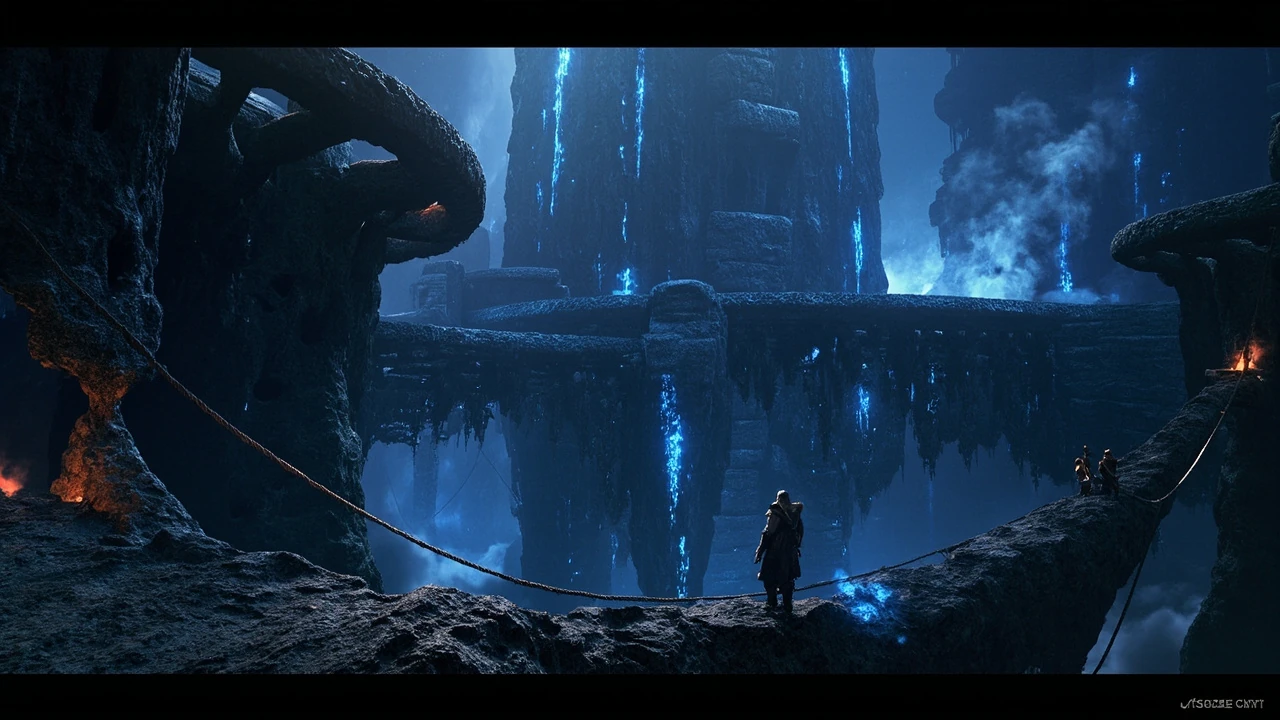

Svartalfheim as a game design problem
A dark, glittering cavern world full of master craftspeople and ancient grudges is not a backdrop. It is a systems problem. Designers who treat the realm as a passive texture end up with a biome that looks striking in marketing art and dies within twenty minutes of play. The realms that survive player attention in open world and RPG projects share a few traits: a clear biophysical rule, a set of recurring encounter shapes, and a reason to keep moving through space.
What svartalfheim actually is in the source material
Game design works best when it respects the grain of its source. Two facts from the older Scandinavian material shape almost every modern interpretation of the realm.
- It is below ground, not beside the other realms. The surviving sources place the dark elves in a subterranean world reached by descent. That single fact drives lighting, audio, navigation, and pacing decisions in any game that uses the name.
- Craft and metalwork are central. The same sources connect the dark elves to smithing, to magical objects, and to the kind of fine work that is hard to render at scale. Modern games inherit that as a thematic through-line: gilded armor, rune-etched walls, masterwork weapons as quest rewards.
Designers who want to deviate from those two anchors can, but they should do it deliberately. Most successful adaptations keep the underground setting and treat craft as the through-line, even when they change the politics, the aesthetic palette, or the relationship to other realms. A game that puts svartalfheim on a sunny plateau has usually lost the one environmental contrast that makes the realm feel distinct in a player’s memory.
The biophysical rule that drives every other decision
Every coherent environment in a game answers a single biophysical question. For a forest, the question is how light filters through canopy and what the undergrowth rewards. For svartalfheim, the question is: what happens to a civilization that lives entirely underground and survives by mining, forging, and trade?
Answering that question with one sentence is the most useful exercise a level designer can do. The sentence becomes the lens for every asset, light, and audio pass that follows. Three answers are common in shipped games, and each one cascades into different production choices.
| Biophysical premise | Visual cascade | Gameplay cascade | Risk if poorly executed |
|---|---|---|---|
| Phosphorescent minerals replace sunlight | Cool blue and violet key, warm ember accents near forges, high contrast shadows | Stealth and detection revolve around mineral nodes; navigation uses glow density as a wayfinding signal | The level becomes a uniform purple wash with no readable geometry |
| Volcanic heat and magma channels | Red and orange rim light, steam and ash volumetrics, basalt rock vocabulary | Heat damage zones, plate tectonics as scripted events, forge districts radiate outward from heat sources | Every underground zone starts to look like every other lava cave in the genre |
| Bio-luminescent flora and fauna | Soft green and cyan secondary light, organic curves in rockwork, pollen or spore particles | Sanctuary pockets inside hostile space, herbalism and alchemy loops, fauna used as mounts or pack animals | Players read it as a generic mushroom cave rather than a specific culture |
Pick the premise early, write it down, and refer back to it whenever an asset feels generic. The premise is also the answer to a producer who asks why a particular prop needs a custom shader: the prop is part of the biophysical rule, not a decoration.
Lighting and rendering choices that survive player attention
Underground lighting is the most common failure point for svartalfheim-themed zones. The instinct is to dim everything and add a few warm point lights near NPCs. That approach produces a flat, low-contrast image that ages poorly and hides the level art. A few principles hold across real-time engines.
- Build a three-tier key. One dominant light source establishes the time of day equivalent. A second tier of practical lights (forges, crystal clusters, fungi) anchors the player. A third tier of rim and bounce light separates actors from background. Without the third tier, characters blend into walls.
- Treat the camera as the constraint. Cinematic underground shots can carry extreme contrast. Gameplay cameras cannot. Validate every key with the actual in-game camera path, not with a beauty shot.
- Use volumetrics sparingly. One persistent atmospheric layer sells scale. Two or three layered volumetrics in a single room usually turn into a haze that obscures encounter readability.
- Bake what the camera will not move. Long view distances and large static cavern walls are usually baked for performance. Mark those zones on the level block-out before art pass so lighting artists know which surfaces they cannot tune at runtime.
A common optimization mistake is to push mineral glow into a screen-space bloom pass. Bloom sells the idea of light but flattens the source geometry. Where possible, give each glow source a real emissive material and let the bloom be a finishing layer. That change alone tends to make a cavern read as inhabited rather than decorated.
Level pacing and player wayfinding
Subterranean levels suffer from two related problems: players cannot see landmarks from a distance, and players cannot tell whether they are making progress. The fix is to design verticality and to invent landmarks that survive the lack of a horizon.
Three tools work in almost every genre.
- Vertical landmarks. A central spire, a hanging bridge, or a chasm with a visible bottom is the underground equivalent of a distant mountain. Players orient around it even when they cannot reach it.
- Color and material waypoints. Change the dominant rock vocabulary as the player moves from district to district. Black basalt, red iron-rich stone, pale limestone, and crystal-veined granite are all visually distinct at distance and read as a transition even before the player reads a sign.
- Acoustic wayfinding. Deep caves should have long reverb tails, distant water drip, and the low rumble of the world above. A forge district should sound tight and metallic. Audio is the cheapest way to give players a sense of arrival before they have line of sight to a new area.
For an open world game, the same tools scale up. The realm becomes a region on the map with a single visual identity (for example, dark stone and gold), a single acoustic identity (long reverb, metallic strikes), and a set of named locations the player recognizes from the HUD. The named locations matter more than the geometry, because they are the only way the player can plan a route in a space without landmarks.
Enemy and encounter design underground
Underground combat raises a specific set of problems that the surface rarely surfaces. Visibility is limited, retreat paths are constrained, and audio cues are unreliable. Encounter designers should answer three questions for every encounter shape used in the realm.
- What is the player’s information state? In a forest, sight lines are long. In svartalfheim, sight lines are short. Encounters that rely on telegraphed enemy wind-ups need larger wind-ups or a clearer audio cue underground, because the player may not see the enemy until late.
- What is the player’s escape option? Underground, the player can usually retreat into a chokepoint rather than around a hill. Design encounters that account for that by either rewarding the chokepoint (the chokepoint holds) or by removing the option (the chokepoint collapses).
- What is the role of the environment? The best underground encounters use the cave as a third participant. Collapsing floors, rising magma, mineral clouds that block line of sight, and forge plumes that hide ranged attackers all use the realm’s identity to make combat feel different from the surface game.
A useful internal rule: if an encounter in svartalfheim can be lifted into a forest map with no changes, the encounter does not yet use the realm. Replace one piece of geometry or one ambient effect with something that only exists in the underground setting and re-validate.
Quest and narrative hooks that earn the realm’s name
Quests that take place in svartalfheim should answer a question the surface cannot. The strongest hooks for the realm tend to fall into four families, each of which is supported by the older source material in some form.
| Quest family | Player fantasy | Production cost | Risk |
|---|---|---|---|
| The commission | Acquire a masterwork object from a master craftspeople | One signature weapon or armor set, one quest hub, one named NPC | The reward has to be genuinely desirable in the meta, or the quest reads as filler |
| The debt | Settle a generational obligation owed to or by the dark elves | One branching dialogue tree, two resolution states, one location variant | Forced moral choice framing can feel manipulative if the player has no real information |
| The intrusion | Stop a hostile force that has entered the underground through a breach | One set piece encounter, one breach asset, one traversal puzzle | Generic military framing can flatten the realm’s identity |
| The kin question | Investigate the relationship between the dark elves, the light elves, and the dwarves in a given setting | One lore document, one optional discovery sequence, no new geometry if the world already has the locations | Can become exposition-heavy if the discovery is not gated by gameplay |
Notice that three of the four families depend on named NPCs and on objects the player will remember. The cheapest and most expensive production risks both live in the same place: the reward. A signature weapon that no one uses is a sunk cost. A signature weapon that becomes the build-defining piece for a year of live operations is a flagship asset. Quest design in a named realm is a long bet on retention, not a short bet on completion rate.
Cultural and political design in the realm
The political shape of svartalfheim is one of the most variable pieces across modern games, and that variability is useful. The source material does not give a single canonical government, so designers can pick a structure that fits the rest of their world.
Three structures appear most often in shipped titles.
- Guild confederation. Independent craft guilds negotiate on equal terms. Good for player factions that need to pick a side without breaking the world.
- Sorcerous monarchy. A single ruler holds power through mastery of a forbidden craft. Good for a single strong antagonist and a single clear quest target, but it tends to flatten the realm into a single villain.
- Covenant of houses. Noble houses rule by inheritance, with craft as a marker of status rather than a direct lever of power. Good for political intrigue quests but expensive in named NPCs and dialogue.
Each structure has a different cost in named characters. A guild confederation can run on three named NPCs and a generic guildhall set. A covenant of houses usually needs at least six named NPCs to feel distinct. Budget the named NPC count at the same time as the level block-out, because dialogue recording, motion capture, and barks are the long pole in production for any realm that needs to feel inhabited.
Audio identity for the dark elf realm
Audio is the cheapest way to make svartalfheim feel different from a generic cave. The realm’s identity is a small set of recurring sounds layered on top of the usual underground bed.
- Metallic ring. A short, bright bell tone or hammer strike, used sparingly. The point is association, not constant noise.
- Deep low rumble. A sub-audible layer that signals the scale of the cavern. It can sit on a loop and never change, and the player will still feel that the space is large.
- One signature creature or wind. A single recurring non-combat sound that the player learns to associate with the realm. A breathy wind, a distant choral hum, or a specific bird call in a cave (small, but the strangeness sells the place).
- Reverb tail tuning. A longer tail than any other biome. The tail is the cue that says “this is the underground,” and it costs almost nothing to implement.
This article treats svartalfheim as a design problem rather than a trivia entry. The point is to give a developer, environment artist, or level designer a working mental model for the realm, the choices it forces on production, and the trade-offs that come with each option. A short sourcing note: most of the canonical imagery used in modern games traces back to the medieval Scandinavian corpus, where the dark elves appear in the Eddas and later saga material as a distinct group of beings living under the earth, often connected to craftsmanship and, in some sources, to the dead. The English overview of those figures is covered on the Svartálfar, which provides useful background for this point. page. Anything in this article that touches on real history, modern game releases, or engine behavior is either within the public lore record or clearly labeled as design interpretation.
A useful sanity check during mixing: mute the music and the dialogue, and listen only to the ambient layer while playing through the realm. If the player can still tell that they are in svartalfheim rather than in any other underground biome, the audio identity is working. If they cannot, the ambient layer is doing decoration rather than design.
Engine and tooling considerations
Subterranean open spaces stress rendering in ways that surface levels usually do not. The failure modes are predictable, and most of them can be designed around in the block-out phase rather than discovered in QA.
- Long view distances without skybox fallback. In surface levels, the skybox carries a lot of the perceived draw distance. Underground, the equivalent is a large, mostly static cave wall. Plan for streaming or for a baked backdrop when the player can see across a chasm.
- Light count budgets. Underground scenes tend to over-spend on point lights because natural sunlight is replaced with many small sources. Track light count per room and per portal during the block-out. When the count spikes, consolidate to fewer, larger sources with a wider radius.
- Occlusion culling. The dense geometry of cave walls usually culls well, but only if the level is broken into sensible cells from the start. A single 200-meter cave is a culling problem. Three connected 60-meter caves with the same total length are not.
- Memory for rock variants. Underground levels live or die on the variety of rock materials. A small set of high-quality rock materials used with intention reads better than a large set used at random. Decide on the variant count and the rule for swapping variants in the level design phase, not in the art pass.
None of these choices are engine specific, but the specific budget numbers will vary by engine and platform. Validate the budget on the lowest-spec target, not on the development kit. Underground levels punish weak hardware harder than surface levels because the player has fewer moments of natural visual rest.
Performance budget for the realm
Performance work for an underground realm starts with the same question as any other biome: what does the player see, and how does that change during combat? The two answers are usually different in the dark elf realm than on the surface.
| Phase | Common surface budget | Common underground budget | Reason |
|---|---|---|---|
| Exploration | Open vista, moderate object count, distant terrain | Claustrophobic geometry, high object count in tight space, no distant terrain | The player is closer to more surfaces, so the same object count per square meter feels denser |
| Combat | Many characters on screen, particle layers, dynamic lights | Fewer characters, more environmental effects, fewer dynamic lights | Light count is already a constraint underground, so combat effects have to compete with the ambient lighting |
| Set piece | Brief scripted sequence, large draw distance, particle heavy | Brief scripted sequence, close camera, debris heavy | The set piece usually takes place in a smaller space underground, with debris replacing the open-air particles |
| Traversal | Long sight lines, predictable streaming | Short sight lines, constant streaming | Underground traversal often crosses many small cells rather than a few large ones |
Use this kind of table as a starting point and then replace the numbers with measured values from your own target hardware. The shape of the budget is more consistent across projects than the specific numbers.
Validation and playtesting underground
Playtesting a dark realm requires a different observation list than playtesting a forest. Players report problems in the same words, but the underlying cause is usually different.
- Disorientation. On the surface, the cause is usually a poorly placed landmark. Underground, the cause is usually a missing landmark. Add a vertical anchor or a color shift before rebalancing any other system.
- Lost progress. On the surface, the cause is often a navigation bug. Underground, the cause is often that the player cannot see how far they have come. Add a travel distance indicator or a more readable return path before debugging the navigation graph.
- Combat frustration. On the surface, the cause is usually enemy tuning. Underground, the cause is often that the player cannot see the enemy. Enlarge the wind-ups, add an audio cue, or restrict the encounter space before rebalancing damage numbers.
- Audio fatigue. Long reverb tails and metallic hits can become wearing after an hour. Validate an entire realm in one sitting rather than in short playtest loops. The accumulation of fatigue changes the player’s report.
Internal playtests should always include at least one session where the player is asked to navigate from one named location to another with the map closed. If the player cannot do it after two attempts, the realm’s wayfinding is the problem, not the player’s skill.
Common failure modes in shipped underground realms
Looking across released games, a small set of failure modes recurs. They are worth naming so the team can spot them early.
- Uniform purple. Every underground zone uses the same key light and the same rock material. The realm looks distinct in isolation and identical in context.
- Linear corridors. Designers fall back on tunnels because tunnels are safe to block out. The result is a realm that feels like a sewer rather than a city.
- Generic NPCs. The dark elves use the same character rig, the same idle set, and the same voice pool as the surface humans. The realm’s identity collapses.
- Untranslated reward. A masterwork weapon is the quest reward, but its visual treatment is identical to a common weapon. The player never feels that the object came from this place.
- Verticality without function. The block-out has a chasm, but nothing uses the chasm. Players see the depth and then ignore it because it does not change how they play.
Each of these failure modes is a design choice that drifted during production. The fix is almost always a small one, but the fix has to be applied at the level of the realm, not at the level of a single asset. A single re-skinned NPC will not save a uniform purple world.
Integrating svartalfheim with the wider game
The realm is usually one region in a larger world. The interface between the realm and the rest of the world is where most projects lose coherence. Three integration points deserve explicit attention.
- The transition. The player has to enter the realm somehow. A short transitional space, with its own audio and lighting, is the difference between a realm that feels like a destination and a realm that feels like a texture swap.
- The economy. If the realm produces a unique resource, the resource has to matter in the wider game. If it does not matter, the realm becomes a quest location and nothing more.
- The reputation system. If the game has factions, the dark elves usually need one. A realm with no faction presence in the wider political map tends to feel optional, even when it is not.
None of these integration points are expensive on their own. They are expensive only if they are added at the end of production, when every change is a regression risk. Plan the transition, the economy item, and the faction at the same time as the realm’s biophysical rule.
Build pipeline notes for the realm
Underground levels are unusually dependent on a stable build pipeline because the player never leaves the realm once they enter it. Pop-in, shader compilation hitches, and streaming stalls that would be a minor issue on the surface become load-bearing failures underground.
- Shader compilation. Underground scenes use a wider range of emissive materials than surface scenes. Pre-warm shaders in the level streaming thread, not on the main thread, and budget the pre-warm time against the streaming budget.
- Streaming cells. Define the cell graph in the block-out. Test the cell graph on the lowest-spec target before any art is added. Adding art after the cell graph is set usually requires re-cutting the cells, which is a long pole of work.
- Build determinism. Underground levels use a lot of baked lighting. Make sure the bake is deterministic across machines, or the QA team will spend a disproportionate amount of time on lighting bugs that only appear on one workstation.
- Memory budget. Underground levels tend to accumulate unique geometry because the rock vocabulary varies more than a forest floor does. Track unique mesh count and unique material count as first-class budget items.
These are not glamorous problems, but they are the reason that some realms ship smooth and others ship with a patch. The technical artist and the level designer should agree on the cell graph and the shader pre-warm list in the first week of block-out, not in the last week of polish.
Working with a broader pipeline at a partner studio
Many projects build named realms as part of a co-development or work-for-hire engagement. A few production habits make the realm easier to hand off and easier to maintain after launch.
- Single biophysical sentence. Put the one-sentence biophysical rule at the top of the design document. Anyone joining the team can read it in thirty seconds and orient themselves.
- Single source of truth for the audio identity. The audio identity should live in a single short reference, with three or four named cues, rather than scattered across the audio team’s spreadsheets.
- Single named NPC list. The named NPCs in the realm, with their roles, should be on one page. This list is the closest thing the realm has to a cast list, and it is the document that the writing team, the audio team, and the animation team will all reference.
- Single asset whitelist. The rock variants, the lighting templates, and the prop set should be whitelisted, not banned. A whitelist tells the team what to use, which is faster than a blacklist that tells them what to avoid.
For studios that also handle the wider pipeline, a page like the studio’s full cycle game development overview can help frame the realm as one phase inside a larger production rather than a standalone task.
Adapting the design to different genres
The biophysical rule, the lighting plan, and the audio identity are portable across genres. The implementation is not. A short comparison helps a team pick the right cuts when they adapt the realm to a new brief.
| Genre | What stays | What changes | Production cost driver |
|---|---|---|---|
| Open world RPG | Biophysical rule, named NPC set, signature reward | Streaming cells, faction integration, economy item | World map and fast travel design |
| Linear action-adventure | Lighting plan, audio identity, vertical landmark | Quest family, encounter set pieces | Set piece scripting and cinematic blending |
| Survival crafting | Biophysical rule, rock vocabulary, audio identity | Crafting recipes, resource distribution, weather inside the cave | Resource node graph and inventory tuning |
| Multiplayer extraction | Wayfinding tools, named locations, audio identity | Encounter pacing, light budget per player, loot distribution | Server-side streaming and replication cost |
| Strategy or 4X | Political structure, named leaders, signature unit | Map scale, turn pacing, economy weight | UI for the underground economy |
The same realm can be designed for several of these genres in parallel, but only if the biophysical rule and the audio identity are written once and reused. Without that shared core, each genre adaptation becomes a separate production.
Live operations and post-launch support
If the realm launches as part of a live game, the production plan has to account for the year after launch. Underground regions are unusually expensive to revisit because the player’s memory of them is detailed. A small art pass on a forest may pass unnoticed. A small art pass on a dark elf capital will be screenshotted and compared.
- Reserve a named NPC slot. One slot in the launch cast should be left for a post-launch addition. The cost of adding the NPC is roughly the same whether it is in the launch or in a later season, but the value is higher later, when the player base is established.
- Reserve one signature reward slot. A signature weapon or armor set is a retention lever. Holding one slot back for a later season gives the live operations team a way to bring players back to the realm.
- Reserve one audio stem. One signature sound design piece, layered into the realm at launch, can be re-mixed for a seasonal event. The cost of the remix is small compared to the cost of authoring a new signature sound.
These reservations are cheap if they are made at the start of production and expensive if they are added at the end. They are also the most common difference between realms that grow over the life of a live game and realms that stay frozen at launch.
Frequently asked questions
Is svartalfheim a real place or a game invention?
It is not a real place. It comes from the older Scandinavian source material, where it is described as a subterranean home of the dark elves, a group of beings associated with craftsmanship. Modern games take the name and the basic premise from those older sources and build the world design on top of them.
What is the difference between svartalfheim and Nidavellir in modern games?
That depends on the game. In the older Scandinavian source material, the relationship between the dark elves and the dwarves is debated, and several modern game adaptations treat them as overlapping or even identical groups. Other games treat them as separate cultures that share an underground environment. The choice has real consequences for quest design, because a merged reading supports shared lore and a separated reading supports two distinct quest lines.
What is the single most important design choice for a svartalfheim-themed zone?
The biophysical rule. The one-sentence answer to “what is the underground like here” drives lighting, audio, props, and pacing more than any other decision. Without that sentence, the zone becomes a generic cave. With it, the zone has a reason for every asset.
How long should a player spend in a svartalfheim-themed zone in a single session?
That depends on the genre, but the practical ceiling is shorter than the surface equivalent. Underground zones depend on a small set of environmental cues, and those cues fatigue. Plan for sessions of forty-five to ninety minutes, and give the player a way to leave the zone for a surface hub between sessions.
What is the cheapest way to make the realm feel different from a generic cave?
Audio. A longer reverb tail, one metallic ring, and one signature non-combat sound cost almost nothing to implement and they do more for the player’s sense of place than any single prop.
Do players care about the lore accuracy of the name?
Players who recognize the name care. Players who do not recognize the name still benefit from the lore accuracy, because the lore is what gives the design its coherent shape. Treating the name as a flavor tag tends to produce inconsistent worlds. Treating the name as a design constraint tends to produce coherent ones.
How does the realm work in multiplayer?
The same way it works in single player, with two adjustments. First, the audio identity has to survive the presence of other players and their effects. Second, the encounter pacing has to account for the larger information state of a squad. Neither adjustment is expensive, but both are necessary.
What is the biggest production risk for the realm?
Uniformity. The realm is large, dark, and detailed, which means that small inconsistencies are easy to miss and hard to fix later. A short design pass that names the rock variants, the lighting templates, and the prop set is usually the cheapest insurance against a uniform purple world at launch.
Leave a Reply