



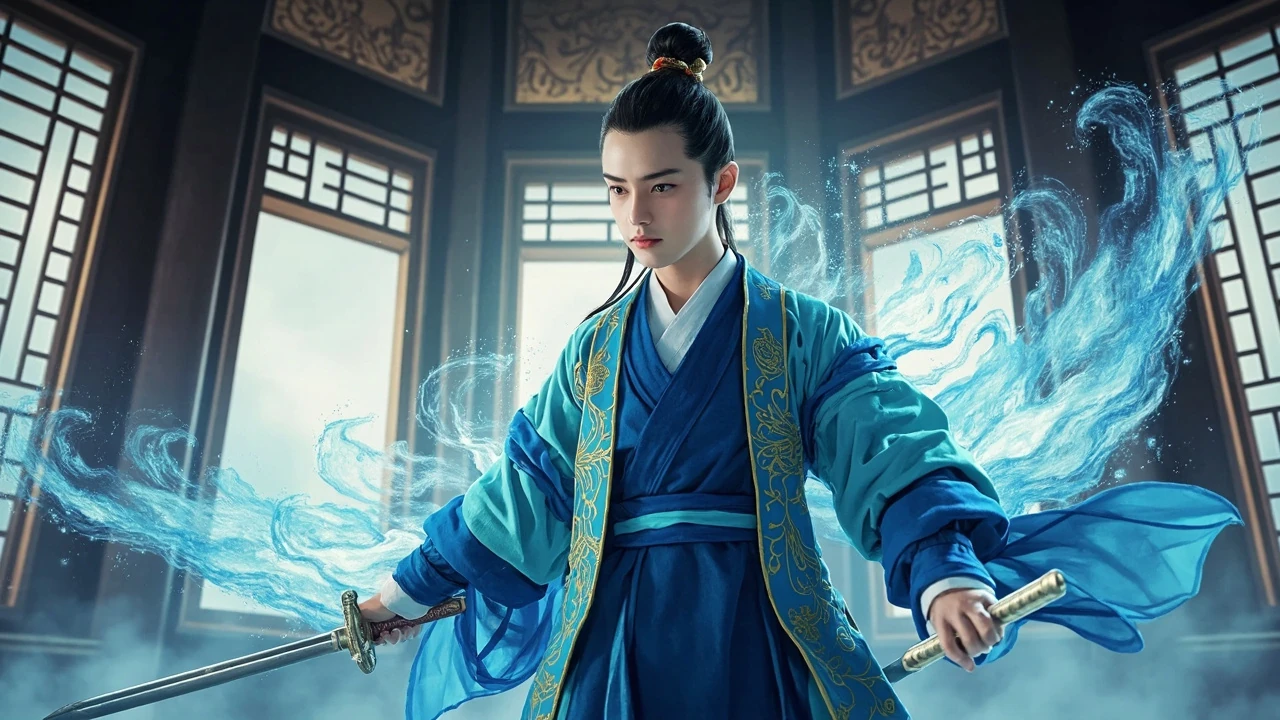

Xingqiu in Genshin Impact: kit, build, and team design
A well-built Xingqiu quietly solves more Genshin Impact team-building problems than almost any other four-star in the game. He sits off-field, applies Hydro on a consistent rhythm, feeds Hydro-based reactions, and supplies a small package of damage reduction, interruption resistance, and minor healing for the on-field character. The first time you swap him in next to a Pyro or Electro main DPS, the practical value becomes obvious: the same enemy that shredded your team in two combos suddenly feels almost manageable, and your reaction damage climbs without changing your main carry’s gear.
this page treats Xingqiu the way a careful design-focused publication should. The goal is not to recite a wishlist of weapons or to chase the largest possible damage number. The goal is to explain how his kit actually works, why his stat priorities are unusual for a Hydro support, and what his role teaches us about reaction-driven team design in a live-service action RPG. Readers who only need a quick artifact set can scroll to the build summary; readers who want to understand the design logic can read the kit analysis, stat priority table, and team archetypes in order.
One quick note on sourcing. The mechanical details, role description, and stat priorities here are drawn from the public Xingqiu build reference on IGN, which is the verified authority page for the current read on his kit, his off-field damage profile, and the way the developers have tuned him around Hydro application. Where the page excerpt cuts off, the rest of the article is built on the same kind of publicly observable kit behavior, not on speculation.
Who Xingqiu is in the fiction and the roster
Xingqiu is presented as the second son of the Feiyun Commerce Guild in Liyue, a literature-loving swordsman who secretly writes martial-arts novels under a pen name. In mechanical terms, he is a four-star Hydro sword user classified as a sub-DPS whose damage is almost entirely delivered through his Elemental Burst, not through his normal attacks. That distinction matters: a character whose power lives in the Burst plays a different role in a team than a character whose power lives on-field, and the developers have leaned into that distinction by keeping his field time short and his off-field value high.
From a game design perspective, Xingqiu is one of the clearest examples in Genshin Impact of an off-field enabler. He applies Hydro through coordinated attacks generated by his talents, not by standing in front of the enemy and swinging. That decision opens room for the player to occupy field time with a stronger on-field carry while Xingqiu’s summoned rain swords keep ticking damage and reactions in the background. The trade-off is that the carry still has to interact with Xingqiu’s mechanics, such as the Normal Attack triggers on his rain swords, to extract his full value, which is a deliberate gating choice rather than an oversight.
For a developer audience, the useful framing is that Xingqiu is a “press once, then forget” support whose contribution is gated by how well the rest of the team respects his trigger rules. For a player audience, the same framing translates into a simple promise: build him correctly, learn two or three attack patterns, and he will do useful work in almost every content mode the game offers. The same source material notes that he is available on all banners at a low drop rate, can be acquired through Paimon’s Bargains, and shows up occasionally as a featured four-star on rate-up banners, which is part of why so many accounts end up with a copy of him by accident.
How the Xingqiu kit actually works
Xingqiu’s kit has three moving parts that interact with each other: his Elemental Skill Guhua Sword: Fatal Rainscreen, his Elemental Burst Guhua Sword: Raincutter, and the passive talent that converts his sword rain into a defensive layer. Understanding those parts is the difference between treating him as a generic Hydro applicator and using him as the designers intended.
His Elemental Skill generates a small number of Hydro-charged sword projectiles and gives him a short window of damage reduction and interruption resistance on his next few attacks. It is a useful defensive button, especially in content where the on-field character is being staggered constantly, but it is not where the real value lives. The Burst is the centerpiece of the kit, and the entire build conversation flows from that fact.
When Xingqiu casts Guhua Sword: Raincutter, he enters a state where his Normal Attacks trigger rain swords that strike enemies, dealing Hydro damage scaled off his ATK, and applying Hydro on hit. The Burst also applies Hydro to Xingqiu himself on cast, which is important for the freeze and other aura interactions, and it sets up the rain sword window for the rest of the rotation. The number of rain sword waves he can summon is finite, so good Xingqiu play is partly about budgeting those waves against the encounter length, and partly about lining them up with the on-field carry’s biggest damage moments.
The defensive layer comes from the passive talent that converts part of the rain sword damage into a healing-on-hit effect and stacks interruption resistance on the active character. The healing is modest, but in many encounters it is enough to drop a dedicated healer in favor of a shielder or another offensive support, which is exactly the kind of design pressure the developers want a strong four-star to apply. The same verified source notes that a skilled player can often forgo a healer entirely in favor of Xingqiu and perhaps a shielder if there are survivability issues, and that his healing is not exceptional but is just enough to run through the Spiral Abyss.
Reading Xingqiu’s stat screen: why HP% is misleading
New players often read “Xingqiu values HP%” and assume he is a defensive stat stick. The reality is closer to a layered priority where HP% and ATK% both matter for different reasons, and the only defensive stat you can really build around is the damage reduction that his kit gives for free. Working through the priority list in order is the fastest way to avoid a wasted artifact grind, and it lines up with how the verified build reference describes his stat split between HP% for utility and ATK% plus CRIT for damage.
| Stat | Why it matters on Xingqiu | Build priority |
|---|---|---|
| ATK% | Scales his rain sword damage and most of his reaction output. | Primary damage stat |
| CRIT Rate / CRIT DMG | Multiplies his rain sword and skill damage like any DPS stat. | High priority after ATK% |
| Energy Recharge | Needed to keep his Burst up; he is energy-hungry without particle help. | Target 180-220% in solo Hydro |
| HP% | Scales a small part of his utility and a few constellation bonuses. | Useful but not the main lever |
| Elemental Mastery | Only worth investing in on reaction-focused Hyperbloom or Taser teams. | Conditional |
| DEF% / Physical DMG | Not part of his damage path. | Avoid |
Two practical consequences follow. First, an ATK% sands is usually correct for a generalist Xingqiu, even though HP% sands are often recommended by older guides that put too much weight on his utility scalings. Second, Energy Recharge is not optional in solo Hydro teams. Without enough particles from teammates, his Burst sits on cooldown and the entire kit collapses into a small Skill press every twelve seconds. Treating Energy Recharge as a real stat rather than a crutch is one of the strongest design lessons Xingqiu teaches, and it is the reason his recommended ER target keeps creeping up in newer team comps.
Weapons, artifacts, and the build he is actually designed for
Xingqiu’s signature support weapon is Sacrificial Sword, which appears on standard banners and has a refine path that lets him cast his Skill twice in a row. That double cast is a real quality-of-life upgrade because it refreshes his defensive window and generates more particles to fuel his Burst, but the same effect is approximated by several other weapons that are easier to obtain. The build he is designed for is intentionally friendly to free-to-play players, which is part of why he has stayed a top-tier support for so long, and the verified source describes his gearing as fairly standard with strong interactions with weapons many players already own.
For a standard playstyle, the goal is to keep his Burst active, trigger rain swords on every on-field Normal Attack, and let the rest of the team consume the Hydro he applies. For a reaction-focused playstyle, the same kit leans harder into Elemental Mastery because his Hydro application is what triggers Vaporize, Electro-Charged, or Hyperbloom in the first place. The two playstyles share the same character but want different stat screens, and the difference shows up in the artifact set as much as in the weapon choice.
| Build archetype | Weapon examples | Artifact set | Main stats |
|---|---|---|---|
| Generalist sub-DPS | Sacrificial Sword, Favonius Sword, Festering Desire | 2pc Hydro DMG / 2pc ATK%, or Emblem of Severed Fate 4pc | ATK% sands, Hydro DMG goblet, CRIT circlet |
| Reaction support | Sacrificial Sword, Iron Sting, Toukabou Shigure | 2pc Elemental Mastery / 2pc Elemental Mastery, or Gilded Dreams 4pc | EM sands, EM or Hydro DMG goblet, EM or CRIT circlet |
| Battery variant | Favonius Sword, Sapwood Blade | Emblem of Severed Fate 4pc with Energy Recharge focus | ER sands, Hydro DMG goblet, CRIT circlet |
For a longer-form, weapon-by-weapon read that the verified external source uses, the same IGN guide provides a more exhaustive tier list, and it explicitly notes that he works exceptionally well with standard-banner four-star swords. The point to keep in mind is that the developers’ intent is that a four-star weapon with a good refine can be a permanent solution; they have deliberately given him strong interactions with weapons many players already own rather than locking his best play behind a limited five-star.
Constellations, refund policy, and how to evaluate them
Xingqiu is one of the few four-stars whose constellations meaningfully change his role rather than just multiplying his damage. Two are worth understanding before deciding whether to spend resources on him, and the same verified build page is unusually candid about how his late constellations compare to limited five-stars in the same role.
- Constellation 2 extends the duration of his rain sword waves and improves their Hydro application, which makes him a stronger enabler without any change to the player’s playstyle. This is the most-cited “stop here” constellation in the community.
- Constellation 4 adds a defensive barrier to the on-field character whenever a rain sword hits, which is the constellation that makes “Xingqiu plus shielder” a comfortable no-healer setup in many encounters, and is the one that pushes him over the line for a lot of Spiral Abyss runs.
- Constellation 6 boosts the damage of his rain swords based on a defensive stat, which closes the gap between his damage output and that of some five-star supports in similar roles, and the same source describes a fully-built Xingqiu as comparable to or better than some five-stars.
From a design point of view, the constellation design is doing two jobs at once. It rewards players who invest in a four-star without invalidating newer players who only have him at Constellation 0, and it lets the developers keep him relevant when newer limited five-stars like Yelan appear in the same role. The verdict for most players is simple: Xingqiu is already strong at C0, and C2 is a noticeable quality-of-life jump without changing the team’s plan. The same source is blunt that after all constellations, he is often better than five-stars in terms of damage, Hydro application, and defensive utility, which is the strongest case you will find for spending pulls on an old four-star.
Team archetypes where Xingqiu earns his slot
The fastest way to evaluate a support is to look at the team archetypes where he is considered almost mandatory. Xingqiu shows up in four of them, and each one teaches something different about how reaction-driven combat is supposed to feel. The verified source explicitly calls out his role in Vaporize and Hyperbloom teams, and his overlap with Yelan is a useful design lens for comparing him to the five-star version of the same job.
Vaporize and reverse-Vaporize teams
The classic setup pairs Xingqiu with a Pyro on-field carry such as Hu Tao or Xiangling, where the rain swords keep applying Hydro and the carry triggers Vaporize on every hit. The same pairing in reverse, where a Hydro carry triggers Vaporize on Pyro-driven hits, is less common but works with characters like Diluc in older content. The team wants Xingqiu’s Hydro application to be reliable rather than bursty, which is why Energy Recharge and rain sword uptime matter more than raw damage, and why the C2 duration extension is so prized in this archetype.
Taser and Electro-Charged teams
In a Taser team, Xingqiu applies Hydro while an Electro driver such as Fischl or Beidou applies Electro, and the result is a chain of Electro-Charged ticks that hit multiple enemies and stagger them. The team wants Xingqiu to apply enough Hydro to keep the aura alive, which means trading some of his damage stat budget for Elemental Mastery when the team is built around the reaction itself. The same trade-off shows up in Hyperbloom, where his Hydro is the first step in a Bloom chain and the damage is front-loaded onto the reaction rather than his personal sheet.
Freeze and Frozen reaction teams
Freeze teams use Xingqiu’s Hydro application to keep enemies locked in place while a Cryo driver such as Ganyu or Ayaka applies Cryo on top. The playstyle is slower than the others but safer, and it lets players skip the usual defensive slots. The interesting design lesson is that Xingqiu’s Hydro is strong enough to keep a Cryo aura on a frozen enemy, which is what makes the archetype work, and which is the reason older Freeze comps were built around his off-field Hydro rather than a driver’s own application.
| Archetype | On-field carry | Xingqiu’s job | Stat lean |
|---|---|---|---|
| Vaporize | Hu Tao, Xiangling, Yoimiya | Reliable Hydro aura for the carry to Vaporize | ATK% and CRIT, moderate ER |
| Taser / EC | Fischl, Beidou, Raiden Shogun in driver mode | Hydro applicator for Electro-Charged chains | Elemental Mastery, enough ER |
| Freeze | Ayaka, Ganyu, Wriothesley | Hydro aura to refresh Cryo and maintain Frozen | ATK% and CRIT, higher ER |
| Bloom / Hyperbloom | Any Electro trigger | Hydro trigger for Bloom seeds, then Electro detonates them | Elemental Mastery, modest ER |
The common thread across all four archetypes is that Xingqiu’s value is created by the team, not by him in isolation. A developer reading this should see him as a deliberately designed “enabler slot” that the team fills with reaction synergy. A player reading this should see him as a safe pull for almost any account that has at least one on-field DPS to pair him with, and the same source frames him as one of the most practical four-stars in the game for exactly that reason.
How to play Xingqiu in practice
Learning the rotation is more important than chasing a single stat. The goal of every Xingqiu rotation is to start the encounter with his Burst up, then keep the rain sword windows overlapping with the on-field carry’s biggest damage moments. The exact timing depends on the carry, but the structure is the same, and the verified build reference describes his field time as minimal at around three to four seconds depending on the weapon, which is a useful target to aim for.
- Start the encounter with Xingqiu’s Burst active. Swap to him, cast Burst, then swap to the on-field carry before the cast animation ends to save field time and respect his off-field design.
- Cast Elemental Skill once for the defensive window and the energy particles. Use it off cooldown unless the carry needs the defensive layer for a specific attack, in which case hold it for a few seconds.
- Trigger rain swords on every Normal Attack of the on-field carry. The simplest way to do this is to make sure the carry’s combo ends on a Normal Attack rather than a Charged Attack, because the rain swords are gated to Normal Attack hits and the team loses value if the carry skips that input.
- Refresh the Burst the moment it ends. If the team is energy-starved, run a battery character or switch to a Favonius weapon before assuming the build is broken, since the same source explicitly flags him as energy-hungry without particle help.
- Swap Xingqiu out for the next support. There is no reason to keep him on the field, which is the single most common mistake newer players make, and which directly contradicts the design intent of his kit.
The reason this rotation is so widely repeated in the community is that the developers tuned his rain sword trigger to Normal Attacks specifically. A team built around Charged Attacks, such as some Ganyu or Yoimiya variants, gets less value out of him per cycle, which is part of the team’s design rather than Xingqiu’s fault. The same trade-off is why his comparison with Yelan is interesting: both are off-field Hydro enablers, but their trigger windows interact differently with the on-field carry’s attack strings.
Common build mistakes and how to recover from them
Most Xingqiu problems are not character problems. They are stat, rotation, or team problems that look like character problems until the player isolates the cause. A short diagnostic list helps more than a long wishlist of “best” artifacts, and the same source is unusually explicit that a few of these failure modes are the most common reasons a new Xingqiu feels weak.
- Burst never comes back up: usually an Energy Recharge problem. Check the team’s particle generation before blaming artifacts, since the verified page describes him as a character whose field time is short but whose Burst is the entire reason he is in the team.
- Damage feels low: usually a CRIT ratio problem or a Hydro DMG goblet not in place. ATK% sands with a Hydro DMG goblet and a CRIT circlet is the safe default, and the same source notes that most of his damage comes from ATK% and CRIT stats rather than HP%.
- Reactions not triggering: usually an aura problem. If the on-field carry is the same element as the enemy, the team needs a second element to break the stalemate, and adding a Pyro or Electro driver usually fixes the issue faster than a stat swap.
- Defensive layer feels useless: usually a Skill timing problem. The damage reduction only applies for a few hits after the Skill, so it has to be cast right before the carry’s burst window, and treating it as a panic button rather than a setup tool throws away most of its value.
- Constellation feels wasted: usually a refund or reroll problem. Constellation 2 is the first big jump, and pulling earlier constellations in isolation is rarely worth the resources, which is the same lesson the same source teaches about four-star banner strategy in general.
- Yelan is “always better” assumption: usually a role confusion problem. Yelan overlaps with Xingqiu but is not a one-to-one replacement, and the same build page is direct that Xingqiu’s defensive utility and Hydro application are good enough to keep him in teams that already run a five-star Hydro.
For developers, this list is a reminder that strong supports tend to fail in predictable ways, and good design documentation would make those failure modes visible to players. For players, the same list is a checklist to walk through whenever Xingqiu “feels weak” in a new team, and it lines up with how the verified build page frames the difference between a properly built Xingqiu and a copy that has been geared by gut feeling.
What Xingqiu teaches about Genshin Impact’s design
A four-star character that has stayed top-tier across multiple major updates and several new limited five-stars is unusual in any live-service game. Xingqiu has done it because the design choices behind his kit are unusually well aligned with the combat system’s core loop, which is reaction-based and swap-driven, and the verified build page frames him as one of the most practical four-stars in the game for exactly this reason. Three of those choices are worth naming for a developer audience.
First, his damage lives off-field, which means he is a multiplier on someone else’s field time rather than a competitor for it. The same source pegs his field time at around three to four seconds, which is short enough that he never fights the on-field carry for screen time, and long enough that the player can still set up his Burst and Skill properly.
Second, his Hydro application is gated to a trigger the player has to opt into, which makes him strong in the hands of a player who learns the rhythm and weak in the hands of a player who ignores it. That gating is the design reason he is not “mandatory” in a vacuum but is mandatory in any team whose carry actually triggers his rain swords on Normal Attacks.
Third, his defensive utility is small and tied to specific talents, which means the developers can balance his damage and his support independently without breaking either. The same source describes a fully-built Xingqiu as comparable to or better than some five-stars on the back of damage output, Hydro application, damage reduction, interruption resistance, and minor healing, which is an unusually long list of utilities for a single four-star talent tree.
For a game studio thinking about long-term support design, the lesson is that off-field enablers with clear trigger rules tend to age better than on-field carries. Players learn to play around them, the kit stays relevant as new carries are added, and the support can be rebalanced without invalidating the player’s investment. A broader look at how the studio organizes its roster and content can be found in pieces on how a gaming development company builds and maintains live-service rosters, which is the closest internal pillar on this site and a useful counterpoint to the character-by-character view this page takes.
When not to bring Xingqiu
There are real situations where a different support is the better call, and pretending otherwise would make this guide less honest. The first is single-target encounters where the carry’s own damage is enough and the team would rather run a shielder or healer, since Xingqiu’s value comes from enabling multiple reaction chains and is harder to see when the encounter does not reward that. The second is encounters with strict elemental mechanics that punish Hydro application, such as shields that require specific elements to break quickly or boss phases that wipe Hydro auras on a timer. The third is a team built around Geo or Anemo carries that do not benefit from Hydro reactions, where Xingqiu’s value drops to his small healing and damage reduction, and another slot would do more work.
A common pattern in character guides is to insist that a strong four-star belongs in every team. The more useful framing is that Xingqiu is a high-floor support that climbs even higher in the right team, and that the right team is the one whose on-field carry triggers his rain swords on Normal Attacks. If the carry does not, another Hydro support is probably a better fit for the slot, and the same build reference is careful to point out that he is “frequently compared” to Yelan rather than a strict replacement, which is a useful way to think about picking one or the other for a given account.
How Xingqiu compares to other Hydro supports at a glance
It helps to keep a quick reference of where Xingqiu sits in the Hydro support ladder, because most of the questions players ask about him are really questions about whether to use him instead of another Hydro. The table below is a working summary rather than a definitive tier list, and it leans on the same verified source for the Xingqiu row.
| Hydro support | Rarity | Main role | Trigger | Notes |
|---|---|---|---|---|
| Xingqiu | 4-star | Off-field Hydro sub-DPS with defensive utility | Normal Attacks on the on-field carry | Energy-hungry, flexible artifact path, strong at C0 and C2 |
| Yelan | 5-star limited | Off-field Hydro sub-DPS with exploration utility | Normal Attacks on the on-field carry, coordinated | Higher personal damage than Xingqiu, less defensive utility |
| Mona | 5-star | Hydro burst support, occasionally on-field nuke | Elemental Burst setup window | Strong in one-shot setups, less consistent in sustained fights |
| Kokomi | 5-star | On-field Hydro driver and healer | Normal Attacks with her own on-field time | Takes the field time slot rather than enabling someone else |
| Barbara | 4-star | Healer with Hydro application | Normal Attacks and Skill, on-field | Healing-first, much lower damage than Xingqiu |
The same logic that makes Xingqiu strong in Vaporize and Taser teams is the same logic that pushes him out of comps where another Hydro is already doing the job. A team with Kokomi on-field and a second Hydro already covering reaction setup does not need a third Hydro slot, and bringing Xingqiu in would crowd the team without changing its damage pattern.
Resource and banner planning around Xingqiu
Because Xingqiu is a four-star, he shows up on almost every banner at a low drop rate, and the same build reference is direct that he can be picked up from Paimon’s Bargains with Starglitter and Starlight if a player has enough currency saved. That changes how it makes sense to plan around him compared to a limited five-star.
- If Xingqiu is a featured four-star on a rate-up banner the player was already planning to pull on, it is worth pulling until at least Constellation 2 if the pity is close, since C2 is the most-cited quality-of-life jump on his kit.
- If Xingqiu is not on rate-up, the safer plan is to spend Starglitter on his copies from Paimon’s Bargains, since the same source flags this as a legitimate acquisition path for free-to-play players.
- If the player is choosing between building Xingqiu and pulling a new five-star carry, the order matters: a four-star support compounds across every future team, while a new carry compounds only on the teams it slots into, which is the same trade-off the build page makes when it calls him one of the most practical four-stars in the game.
- If the player owns Yelan, Xingqiu is still worth building, because the same source notes that his defensive utility and Hydro application are good enough that a team can run both, especially in content where Yelan’s coordinated attacks would overlap with the on-field carry’s rhythm.
The underlying point is that Xingqiu’s value is unusually stable across banner cycles, which is rare for a four-star, and is part of why so many long-time accounts still keep him geared even after pulling newer Hydro options. The same source is direct that after all constellations he is “comparable to and often better than even 5-star characters,” which is the strongest practical argument for keeping him at the top of the support build order.
Frequently asked questions
Is Xingqiu worth building for a new player?
Yes. He is one of the most resource-efficient four-stars to invest in because his weapon options include several craftable or standard-banner swords, his artifact set options are flexible, and his team value is consistent across content modes. A new player with Xingqiu at Constellation 0 and a four-star sword can clear most open-world content and a healthy share of the Spiral Abyss with the right carry, and the same build reference is unusually direct that he has stayed a staple in Spiral Abyss teams for that reason.
What is the best weapon for Xingqiu?
There is no single best weapon; the right answer depends on the team. Sacrificial Sword is the most comfortable generalist pick because it refreshes his Skill. Favonius Sword is the strongest battery pick because it generates particles for the team. Festering Desire is a strong free option if the player owns it from a past event. For reaction-focused teams, an Elemental Mastery sword such as Iron Sting or Toukabou Shigure is competitive, and the same source notes that he works exceptionally well with standard-banner four-star swords, which keeps the gearing cost low.
What artifact set should Xingqiu use?
For a generalist build, Emblem of Severed Fate 4-piece is the most efficient set because it scales his Burst damage with Energy Recharge. For a reaction-focused build, Gilded Dreams 4-piece or any 2-piece Elemental Mastery combination is competitive. A 2-piece Hydro DMG and 2-piece ATK% combination is a fine transitional set while the player farms a better one, and the same build page describes his build as fairly standard rather than locked to one set, which gives new players room to experiment.
What stats should Xingqiu prioritize?
ATK% on the sands, Hydro DMG on the goblet, and CRIT Rate or CRIT DMG on the circlet, with Energy Recharge as a soft requirement. For reaction-only teams, swap the sands and goblet to Elemental Mastery. HP% is a real stat for him but it should not be the main lever, and it usually appears naturally on substats rather than as a main stat, which the same source confirms when it says he values HP% for utility but gets most of his damage from ATK% and CRIT.
Is Xingqiu or Yelan the better Hydro sub-DPS?
Yelan is generally considered the stronger five-star option for raw damage and exploration utility, but Xingqiu provides more defensive value through damage reduction, interruption resistance, and minor healing. In many teams, especially those that already run a healer, the gap is smaller than it looks, and a Constellation 2 or 4 Xingqiu closes it further. The honest answer is that Yelan is the upgrade but not a required one, and the same build page frames them as comparable rather than as a strict hierarchy.
Does Xingqiu work without a healer?
In most teams, yes. His damage reduction, interruption resistance, and minor healing are enough to survive the on-field carry’s burst window in a well-built team, especially when paired with a shielder such as Zhongli. The encounter-by-encounter answer depends on the enemy, but a no-healer setup with Xingqiu is a legitimate design choice rather than a meme, and the same source is unusually direct that a skilled player can often forgo a healer entirely in favor of Xingqiu and perhaps a shielder.
What is the best Xingqiu constellation to aim for?
Constellation 2 is the most impactful general-purpose constellation because it extends the rain sword window and improves Hydro application. Constellation 4 is a strong comfort constellation because of the damage barrier on rain sword hits. Constellation 6 is a damage-focused capstone that closes the gap with limited five-stars. Players should stop at C0 or C2 unless they specifically want the C4 quality-of-life jump, and the same source describes a fully-constellated Xingqiu as comparable to or better than some five-stars, which is the strongest practical argument for chasing the later copies.
Where does Xingqiu fit in the current Spiral Abyss meta?
He remains a flexible slot in many of the strongest teams, especially Vaporize, Taser, and Freeze compositions, and the developers have not introduced a four-star that fully replaces him. The strongest current teams often pair him with characters that benefit from off-field Hydro application, and his value scales with how many of those characters the player owns, which is the same reason the verified build page still calls him a staple in Spiral Abyss teams.
Should Xingqiu be built before or after a five-star carry?
In most accounts, a strong four-star support should be built before pulling a five-star carry, because the support’s value compounds across every team the player will run in the future. A five-star carry without supports often feels weaker than expected, while a four-star support like Xingqiu makes almost any on-field carry perform better. As a rule of thumb, build the support first if the carry depends on reactions and the support does not depend on the carry, which is the same trade-off the same build page makes when it calls him one of the most practical four-stars in the game.
What is the simplest way to use Xingqiu correctly?
Cast his Burst, swap to the on-field carry, perform Normal Attacks to trigger rain swords, and refresh the Burst the moment it ends. Use the Skill for its defensive window during the carry’s burst phase. If the team is energy-starved, swap to Favonius Sword or add an Anemo or Geo battery. The most common mistake is treating him as an on-field DPS, which loses the off-field value that makes him strong in the first place, and which contradicts the design intent the same build page highlights when it pegs his field time at three to four seconds.
Leave a Reply