




BotW memories: how the system works in Breath of the Wild
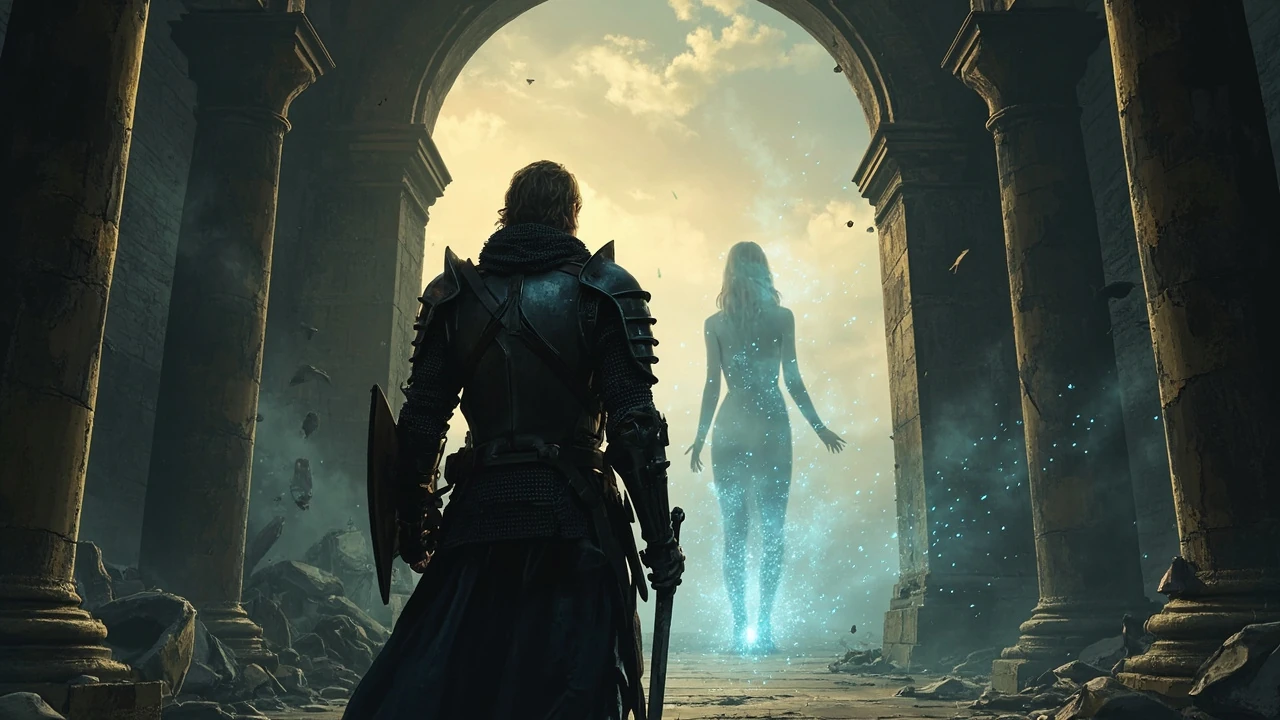
A Link figure standing before a glowing memory scene illustrates BotW memories in a single frame: one figure in the present, one silhouette from a past he cannot reach directly. That visual contrast is also how the system works mechanically. The player collects BotW memories as fragmented cutscenes, then uses them to piece together what happened a century before the main quest begins. Each recovered memory is a short, fully voiced cinematic with no player input, which makes the experience more like reading a visual novel chapter than a typical in-game event.
The memory mechanic in Breath of the Wild is one of the few open-world systems that treats narrative as a map resource rather than a fixed quest line. Players discover the locations in any order, decide when to watch each scene, and gradually rebuild a story that explains the protagonist’s motivation, the ruined kingdom they traverse, and the four Divine Beasts they eventually reclaim. For developers and designers, the system is a useful case study in optional narrative: how to scatter story content across a large map without breaking pacing, and how to keep the player emotionally invested in scenes that the player chooses when to trigger.
This guide explains what the BotW memories system is, how to find and play each one, what each memory adds to the main plot, and why the design holds up as an example of optional narrative architecture. The same mechanics also appear in the sequel, so the terminology and approach transfer to a wider look at the broader The Legend of Zelda series design language.
What BotW memories actually are in gameplay terms
BotW memories are short, prerendered cutscenes that play in first person from Link’s perspective. Each scene reconstructs an event that happened 100 years before the main story: a moment involving Princess Zelda, the four Champions, and the path toward confronting Calamity Ganon. When the player triggers a memory, the camera locks, ambient sound changes, and the scene plays without any input prompts, combat, or pause UI overlay in the standard release.
Mechanically, every recovered memory does three things at once:
- It permanently adds an entry to the player’s Adventure Log, with a screenshot of the opening frame and a short caption.
- It contributes one entry toward a counter that, when all are collected, unlocks a final scene called “Recovered Memory.”
- It gradually reveals the location of the next memory through a process called Impa’s guidance, covered later in this article.
The scenes are not interactive. There is no choice to make, no dialogue branch, and no in-scene way to fail. The only player action is to trigger the memory by interacting with a glowing point at a specific location on the world map. Because the content is fully prerendered rather than scripted in-engine, the production team could pack each scene with detailed facial animation, cinematic camera moves, and detailed voice performance without worrying about runtime cost on Switch hardware.
This is a deliberate design choice. Optional narrative content in open-world games often has to choose between fidelity and discoverability, because the more expensive a cutscene is to render, the fewer of them the studio can afford to scatter across the map. By making memories short, prerendered, and not gated by a single quest, the design team at Nintendo EPD could include enough of them to tell a full story arc without forcing the player through it on the critical path.
How many BotW memories are there, and what order do they tell
There are 18 recoverable BotW memories in the main game, plus one final scene that plays after all 18 are collected. The story they tell is not told in the order the player finds them. Instead, the scenes are arranged so that watching them in any order still produces a coherent emotional arc, because each scene is self-contained in time and place. The internal chronological order, however, is fixed.
The table below lists the 18 memories in the order that events actually happened, with the general narrative beat of each. The location where each memory plays in-game is different from where the event took place in the past, because Link is recovering the memory at a place that still bears a trace of what happened there.
| # | Memory | Chronological role | Where the scene plays out |
|---|---|---|---|
| 1 | The Champions’ Ballad (subtitle varies by version) | Introduces the four Champions | Near a stable in the central region |
| 2 | Zelda’s training and her struggle with the sealing power | Shows Zelda’s doubt | Rural shrine ruins |
| 3 | Meeting at the spring | Establishes the Mipha relationship | Lanayru region |
| 4 | Revali’s boast | Establishes Revali’s rivalry with Link | Rito Village area |
| 5 | Daruk’s song | Establishes Daruk’s character | Goron region |
| 6 | Mipha’s affection | Deepens the Zora storyline | Zora’s Domain |
| 7 | Zelda and Urbosa | Shows Zelda’s bond with Urbosa | Gerudo region |
| 8 | Revali’s reflection | Shows Revali’s hidden respect | Rito Village, later scene |
| 9 | Zelda researches the Sheikah | Shows the sealing-power research | Hyrule Castle library |
| 10 | Daruk’s promise | Shows Daruk’s protective instinct | Goron region, later scene |
| 11 | Zelda prays at the Spring of Courage | Shows her trying to awaken power | Faron region |
| 12 | Mipha heals Link | Develops Mipha’s affection arc | Zora’s Domain, clinic |
| 13 | Zelda and the King | Shows family pressure on Zelda | Hyrule Castle throne room |
| 14 | Zelda researches the springs | Continues the sealing-power arc | Hyrule Castle study |
| 15 | Urbosa’s encouragement | Shows Zelda’s closest adult ally | Gerudo town, later scene |
| 16 | The Champions’ final meal | Foreboding of the coming battle | Central Hyrule |
| 17 | Zelda confronts her destiny | Shows her resolve before the Calamity | Spring of Wisdom |
| 18 | The final moment before the fall | Sets up the Calamity event | Hyrule Field, night |
The labels in the table are paraphrases rather than literal subtitles, and a few scenes are referred to differently in different language releases. The important point is that the chronological order tells one focused story: Zelda’s struggle to awaken a sealing power, the growing affection of the four Champions toward her and toward Link, and the final lead-up to the Calamity. The in-game discovery order is whatever the player chooses, which is what gives the system its open-world feel.
How to find each BotW memory on the map
There are three reliable ways for the player to find a memory, and the design uses all of them to teach different kinds of exploration. A new player typically starts with a hand-holding path, graduates to a hint-based path, and ends with a fully self-directed path.
Impa’s guidance after the first memory
When the player reports the first recovered memory to Impa in Kakariko Village, she gives a short, narrated hint about where the next memory lies. The hint is not a quest marker. It is a verbal clue, sometimes with a vague directional phrase. The design intent is to nudge the player toward the next location without a quest tracker, so that finding a memory still feels like exploration rather than errand-running.
Photographs left by Purah and Robbie
Scattered across Hyrule are 12 photographs taken by the researchers Purah and Robbie, who tried to record the location of each memory 100 years earlier. Each photo shows a real-world landmark as it appeared then, and the player has to match the photo to a location in the present-day map. The match is not always literal. Sometimes the photo shows a tree that has since fallen, a building that is now in ruins, or a viewpoint that is partially obscured.
For developers, the photograph system is a useful example of how to make optional content feel meaningful without making it required. The photo does not unlock the memory on its own, but it makes the hunt for the memory’s actual glowing point more rewarding. It also gives the player a reason to slow down and look at the environment, which doubles as a tutorial for noticing the visual landmarks the world is built around.
Player-driven exploration
Some players will find memories without any hint, simply by climbing high enough to see a glowing point or by following visual cues. The game does not prevent this, and the system quietly supports it. Memory locations are not in dungeons, so a curious player can stumble into a scene during a normal route, and the scene will play without any preparation, because the trigger condition is just proximity and interaction.
What each memory contributes to the main story
Recovered BotW memories are not filler. Each one adds a specific piece of information that the main quest either skips or only references in dialogue. The design uses memories to do three narrative jobs that the main quest cannot easily do because the main quest is a single forward-moving rescue arc.
Character backstory that the present timeline cannot show
For additional context, Zelda, the four Champions, and King Rhoam are the most important characters in the story, but most of them are dead, missing, or hostile at the start of the main quest. The main quest can only show their present-day traces: a journal, a grave, a song, a piece of architecture. The recovered memories are the only place where the player can see these characters as living people with conversations, gestures, and routines. Without the memories, the player would only ever meet a sanitized version of them.
Motivation that justifies the late-game sacrifice
Several late-game plot beats depend on the player caring about characters they have only briefly met in the present. Mipha’s quiet affection, Revali’s bravado, Urbosa’s calm authority, and Daruk’s warmth are all introduced through the memories, not the main quest. By the time the player unlocks each Divine Beast, they have already met the Champion in a memory and built an emotional handle on them, which turns a mechanical dungeon into a character-driven moment.
Closure for the failed war
The main quest shows the result of the Calamity: a ruined kingdom, a sleeping princess, a hostile castle, and four corrupted machines. The memories show the cause: a kingdom that did not fully trust its defenders, a princess who could not awaken her power in time, and a strategy that nearly worked. Watching the memories in order turns a generic “ancient evil was defeated” setup into a specific story about preparation, doubt, and timing.
What happens after you collect all 18 BotW memories
When the Adventure Log shows that all 18 memories are recovered, a final cutscene unlocks automatically. The scene is short, has no combat, and replays one of the emotional beats of the original story arc. It is not a separate quest reward: it is a quiet conclusion that completes the memory arc for the player who chose to complete it.
For the developer studying the system, the final scene is the most important part of the design. It demonstrates that the system is not “extra lore.” It is a fully planned narrative branch that ends in a specific emotional beat, which the player only experiences if they deliberately seek out every memory. Optional content with an intentional conclusion behaves very differently from optional content that is just background decoration. The player’s choice to engage with the system changes the emotional shape of the ending they see, even though the mechanical ending of the game is the same either way.
Memory locations versus present-day landmarks
Because each memory plays in the present but depicts the past, the locations the player visits are sometimes slightly off from the historical location. A field that was once farmland is now forest. A shrine that was once intact is now in pieces. The game’s worldbuilding is built around this gap. The player who notices that the world has changed over 100 years is rewarded with a sense of time depth, and the world itself becomes a kind of archive.
This is one of the most useful techniques in the design. The world is doing two jobs: it is a play space, and it is also a historical record. Recovered memories let the world be a record without forcing the player to read anything. A player who only cares about combat can ignore the memories and never notice that the world has changed. A player who cares about story can collect the memories and see the world as a layered timeline.
How the memory system fits into the wider open-world design
The memory system is one of several optional narrative layers in the game. The other layers are:
- Shrine quests, which often tell a short story in dialogue and visual setup.
- Side quests, which usually have a brief narrative throughline and a single emotional beat.
- Environmental storytelling, where ruins, camps, and the landscape itself imply events.
- Korok seeds, which are mechanical collectibles with minimal narrative weight.
- The Adventure Log, which keeps track of optional content the player has already found.
Memories are the deepest of these layers. They are the only optional content with a fully voiced cinematic, a strict count, and a final scene. Most other optional content either repeats a pattern (Koroks, shrines) or stops at a one-line story (side quests). The memory system is therefore the narrative backbone of the optional content, and the other layers are arranged around it.
How the system compares with other open-world narrative designs
Open-world games that use optional narrative fall into a small set of design patterns. The BotW memory system is a recognizable example of one specific pattern, and it is worth comparing it with the others to see what it gains and loses.
| Pattern | How the player triggers content | What the content delivers | Cost to the player |
|---|---|---|---|
| BotW memories (prerendered scenes) | Explore and find a glowing point | Fully voiced cutscenes that advance a single character arc | Time to explore and match the photo hints |
| Quest-driven flashbacks (dialogue with a narrator) | Talk to a specific NPC at a specific time | Narrated story with limited animation | Following a quest marker |
| Environmental storytelling only | None, the player reads the world | Implied story from the environment | No guarantee the player will notice |
| Audio logs (radio, journals) | Pick up a recordable item | Spoken or written monologue | Listening or reading time |
| Random encounters with named NPCs | World spawn at a region | Short, repeated scenes | Possibly missing the encounter |
The memory pattern is rare because it is expensive. Each scene requires full voice performance, cinematics, and writing. Most open-world games either cannot afford that, or choose to spend budget on a different layer. The reason the design works here is that there are only 18 scenes, and they are short. The studio was able to give each scene a level of detail that would not be practical at a larger scale.
What a developer can learn from the memory system
The memory system is useful as a study object because it solves a specific design problem well: how to give a player a complete story arc inside a world that is otherwise non-linear. Several practical lessons stand out.
- Short, self-contained scenes survive open-world pacing better than long, branching ones. Each BotW memory is short, has no choices, and can be triggered in seconds. The cost of starting one is low, which means the player is more willing to start one.
- A counter with a final reward gives the system a sense of completion. The final scene is a small but real benefit, and the player knows it is there. Optional content with no clear end tends to feel like grinding.
- Discovery hints should respect the player’s intelligence. Impa’s verbal hints, the photographs, and the visual location of each memory all require the player to think, but none of them require a quest tracker. The system stays optional without becoming obscure.
- Optional narrative should not duplicate the main quest. The main quest already explains the Calamity. The memories explain the people involved. Layering story content by topic, rather than by chronology, lets the two systems coexist without overlap.
- Prerendered scenes are a reasonable trade-off when the budget is fixed. Because the scenes are short, the team could allocate a fixed amount of production time to each one and stay on schedule.
None of these lessons are unique to BotW, but the system is one of the cleanest examples of all five applied at once. A studio that is prototyping optional narrative can use the same pattern at a smaller scale: a handful of short scenes, a counter, a final reward, and a hint system that respects the player’s intelligence.
Common questions about finding and using the memories
Because the system is designed to be discovered rather than taught, players often have specific questions about how it works in practice. The list below collects the most common ones, with practical answers.
- The first memory is automatically triggered during the main quest, so the player does not need to find it.
- Photos do not need to be collected in any order. A player can pick up a photo and find the corresponding memory weeks later.
- Some memories are easier to find by sight than by hint, especially in flat areas. Climbing a nearby tower and looking for glowing points is often the fastest approach.
- There is no penalty for triggering a memory while unprepared. Combat, weather, and equipment do not affect whether the scene plays.
- The memory counter only increases when the player watches the full scene, not when the player finds the glowing point.
- The final scene plays automatically once the counter is full, but the player can leave the area and return to trigger it later.
- Memories do not affect the ending of the main quest. The Calamity Ganon fight plays the same way regardless of how many memories the player has collected.
These rules are not stated in the game, which is part of the design. The system is built so that the player’s behavior, not the game’s instructions, determines how the optional content is consumed. That is unusual for a modern open-world game, where most optional content is gated by a tracker or a quest log.
What the memory system does not do
It is also worth being clear about what the system does not do, because that is part of why it works. The memory system does not include choices, branches, or alternate outcomes. It does not change dialogue in the present. It does not unlock new gameplay abilities. It does not give a reward beyond the final scene. It is, in the strictest sense, a single linear story arc that has been cut into 18 short pieces and placed around a map.
For some players, this is a limitation. They want the memory system to affect gameplay, change how NPCs react, or alter the ending. The design does not give them that, and the player’s reaction to the design is part of why the system is a useful case study. Optional narrative can be exactly as limited as a designer wants, as long as the limits are consistent. A system that promises everything and delivers only lore will feel like a waste. A system that promises only lore and delivers it well is honest, and the player can decide whether to engage.
Memory content in the broader Zelda design language
The memory pattern is not unique to BotW, but it is one of the clearest examples of it in the broader The Legend of Zelda, which provides useful background for this point. series. Earlier games in the series used static flashbacks, dream sequences, and text-only diaries to deliver backstory. BotW replaced most of those with the prerendered memory system because the Switch hardware could finally support it without straining the open-world frame budget. The design choice to keep each memory short, prerendered, and out of the main quest loop is what makes the pattern portable: any open-world game with a small budget for cinematics could use the same approach.
When to watch each memory in the main quest
There is no single “correct” order to watch the memories, but the order does affect the player’s experience of the main quest. The recommendations below are practical, not mechanical, and the player is free to ignore them.
- If the player is about to fight a Divine Beast, the corresponding Champion’s memory scenes are most emotionally effective just before or just after the fight. Mipha’s scenes before Vah Ruta, Revali’s scenes before Vah Medoh, and so on.
- Zelda-focused scenes are most effective after the player has reached the Akkala region for the first time, when the player understands the scale of the kingdom Zelda is trying to protect.
- The final “all 18” scene is most effective after the main quest is complete, when the player is already in a reflective state.
- Photos collected in one region often point to memories in a different region, so the player should not assume a photo’s region is the memory’s region.
None of these are required, and the game does not tell the player to do them. They are the kinds of choices that the system hands to the player without commentary, and they are why the system is often cited as a strong example of player-driven narrative pacing.
Internal links to related GameDev and player-guide material
Frequently asked questions
How many BotW memories are there in total?
There are 18 recoverable memories in Breath of the Wild, plus one final scene that unlocks when all 18 are collected. The final scene is not counted as a separate memory in the Adventure Log, but it is part of the memory arc.
Do BotW memories affect the ending of the game?
No. The Calamity Ganon fight, the Hyrule Castle approach, and the post-credits scene play the same way regardless of how many memories the player has collected. The memory arc is a separate, optional conclusion that runs in parallel to the main ending.
What is the first BotW memory and where is it?
The first memory is triggered automatically during the early main quest at the Great Plateau, in the section of the story that introduces Impa. The player does not need to find it. It is the only memory that the main quest is required to trigger.
Do I need all 12 photographs to find every memory?
No. The 12 photographs cover 12 of the 18 memory locations. The other six are found through Impa’s verbal hints, through visual exploration, or by following the glow of the trigger point directly. A player can find every memory without using a single photograph.
Can I rewatch a BotW memory after I have seen it?
Yes. Each memory can be replayed from the Adventure Log at any time. The replay uses the same prerendered cutscene and counts as a complete watch for the counter, which makes replays a useful way to confirm the counter if the player is unsure.
Do BotW memories have any gameplay effect at all?
No. The memories do not unlock abilities, change dialogue, or alter the main quest. Their only effect is to advance the memory counter, which leads to the final scene. The design treats the memories as story content rather than as a gameplay reward.
Is the memory system the same in the sequel?
No. The sequel, Tears of the Kingdom, uses a different optional narrative system based on geoglyphs and a different set of recovered scenes. The general idea of optional flashback content is shared, but the trigger method, the count, and the final reward are different.
Can I trigger a memory during a Lynel fight or in bad weather?
Yes. The trigger condition for a memory is only that the player approaches the glowing point and interacts with it. Combat state, weather, time of day, and equipment do not affect whether the scene plays. The scene plays once and then the player returns to the world exactly as it was before the trigger.
Why does the design use prerendered cutscenes instead of in-engine scenes?
Prerendered cutscenes let the team use higher-fidelity character animation, lighting, and camera moves than the runtime engine can sustain, especially on Switch hardware. Because each scene is short, the production cost of prerendering is manageable, and the open-world frame budget is not affected by scenes the player is not watching.
Is there a way to mark a memory location once I have found a photo?
The game does not provide a way to mark a memory location directly, but players often drop a pin on the map, attach a stamp to a Sheikah Tower, or use the in-game marker system to note where each photo’s matching location is. The community has also built photo-matching guides that show the same view in the present-day map to make matching faster.
Leave a Reply