



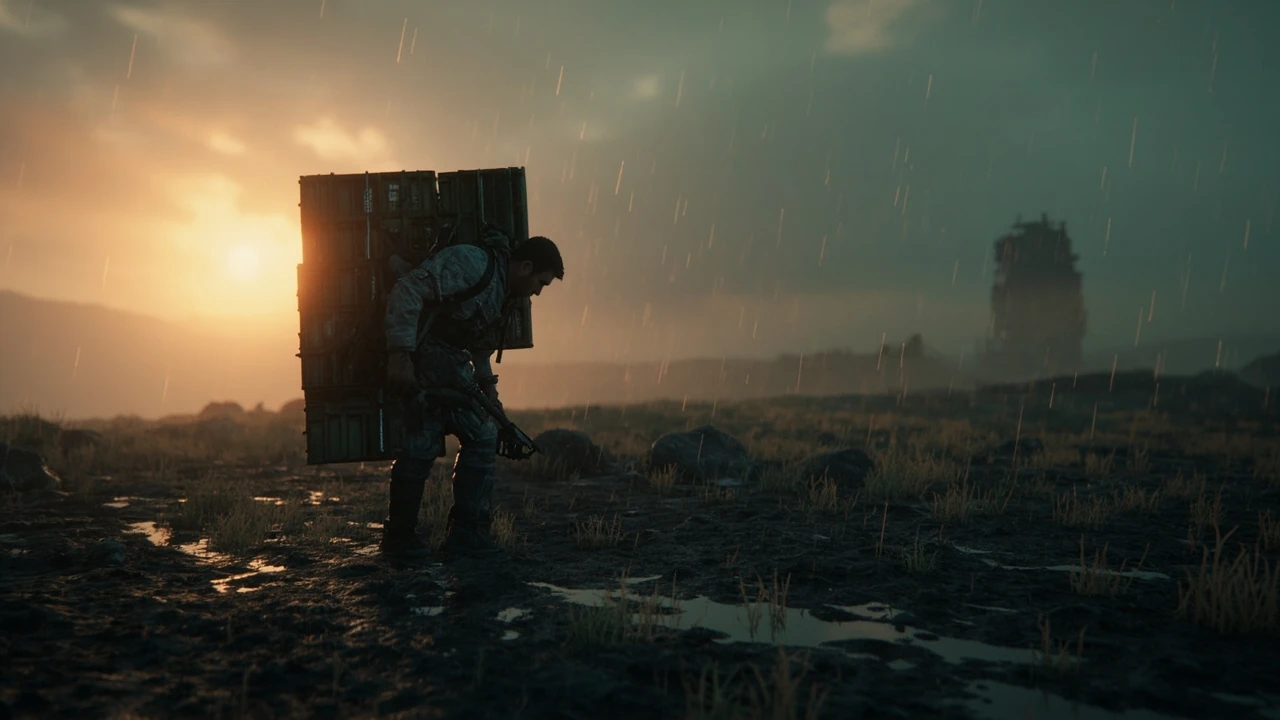

Death stranding walkthrough: reframing the porter’s journey as a GameDev study
A death stranding walkthrough usually reads like a logistics manual: take package A to facility B, avoid the BTs, mind your cargo weight, reset and try again. From a GameDev perspective, the same game is one of the most deliberate systemic designs of the last decade. Hideo Kojima and the team at Kojima Productions built a structure of episodes, orders, and connection levels that turns every delivery into a gameplay loop rather than a fetch quest. This guide treats the game as a design artifact, breaking down the order structure, the porter’s toolkit, the encounter rules around BTs and MULEs, and the asynchronous online layer that quietly reshapes the world.
If you only need a quick list of missions, the IGN walkthrough and strategy guide covers every episode from the Prologue through Episode 14 and lists the seventy main Sam’s Orders in sequence. What follows here is a different layer: how those orders are designed, what each mechanic actually does, and where the production lessons live. The intent is to help a player move through the game more deliberately and to help a developer or technical learner read the design choices behind the experience.
Episode structure and how the order system works
Death Stranding is divided into fourteen episodes that run from the Prologue, titled “Porter,” to the final “Lou” episode, with seventy main orders assigned to Sam Porter Bridges along the way. The IGN walkthrough and strategy guide lists each episode with its associated orders, including named beats like “Episode 2: Amelie,” “Episode 7: Clifford,” and “Episode 11: Clifford Unger.” This naming is not cosmetic. The episode titles reveal the narrative spine, while the orders underneath carry the mechanical and pacing load.
From a design standpoint, the episode-order pairing does three things at once:
- It frames the world as a set of regions, each owned by a different narrative voice. The player is not just walking east to reconnect America; they are crossing a story about that territory.
- It keeps the main loop short. Most orders ask Sam to carry a specific payload to a single facility, prepper, or knot city, with clear weight, fragility, and timefall exposure.
- It gates features. New tools, vehicles, and online functions become available only after a specific order or after a connection level threshold is reached at a facility.
A practical death stranding walkthrough should mirror that structure. Instead of asking “what do I do next,” a player should ask which region the next order belongs to, what cargo it expects, and which facility unlocks after delivery. The order list in the IGN resource covers seventy entries, including Order Number 1 in the Prologue and Order Number 70 in Episode 14. That is a deliberately long arc, and the granularity matters because each order introduces a small system or rule change before returning to the porter loop.
The core porter toolkit and the rules of the road
Before any specific mission is worth solving, a porter has to internalize the basic rules that govern every order. These rules are what the IGN guide compresses under the “Your Biggest Death Stranding Questions, Answered” section, but they each carry design weight that is easy to miss when the focus is on completing the next delivery.
Weight, balance, and stamina
Every package and container has a weight, and Sam has a posture and stamina rating that degrade as cargo stacks up. The first orders are calibrated to teach the player that walking slower is sometimes correct, and that a heavy load on the right shoulder can flip Sam forward into a fall that damages cargo. The mechanical lesson is that the porter’s body is a resource, not a vehicle. Many first-time players try to sprint through their first deliveries and lose more cargo than they would have by walking.
Timefall, cargo condition, and shelters
Timefall is rain or snow that ages anything it touches. Cargo exposed to timefall degrades over time, and the player can reduce that exposure by routing around weather cells, by climbing, or by waiting inside a timefall shelter. The IGN guide documents how to stop timefall rain and snow, and how to unlock and use the timefall shelter system. From a design angle, timefall is the game’s primary threat that has no monster behind it. The horror is environmental, slow, and inevitable, which is what gives the porter loop its tension.
Vehicles, structures, and the chiral network
As connection levels grow at facilities and knot cities, the porter unlocks reverse trikes, trucks, and later a floating carrier. The same progression introduces the PCC, which lets Sam place ladders, anchors, bridges, generators, and timefall shelters in the world. The PCC and the chiral network are the structural backbone of the game, and they are also what the asynchronous online layer plugs into. The IGN resource treats vehicles and the PCC as separate guides because they are separate systems in production, but the player encounters them as one connected progression.
BTs, MULEs, and the two combat philosophies
Death Stranding has two main enemy types, and they are designed to enforce opposite playstyles. The IGN walkthrough keeps them in two distinct pages, “How to Kill or Avoid BTs” and “How to Take Down and Defeat MULEs,” and that separation is intentional.
BTs and the catcher
BTs are invisible until Sam equips a sensor or his Odradek. When detected, they manifest as hand-shaped silhouettes in the air and eventually drag Sam into a tar-filled encounter. The standard counter is nonlethal. Sam carries a cargo of human waste or a hematic grenade and throws it. The hairloss on the BB is a casualty the game explicitly tracks. The design lesson is that violence against BTs is messy, costly, and noisy, while stealth and routing around them is cleaner but slower. The game rewards careful planning and punishes detection hard.
MULEs and human antagonists
MULEs are human porters who have gone rogue and now attack to steal cargo. They use rubber bullets and nonlethal weapons because, in the fiction, they want deliveries, not bodies. The standard counter is lethal, and the game gives Sam bola guns, assault rifles, and later a full weapons tree. Where BTs are an environmental hazard, MULEs are a territorial one, and they live in MULE camps that the player can clear as a side activity. The IGN guide documents both playstyles because the game deliberately frames them as different systems rather than a single combat system with two skins.
Online systems, connection levels, and the shared world
One of the most discussed design choices in Death Stranding is its asynchronous online layer. The game is playable entirely offline, but when a player signs in, the world becomes quietly shared. The IGN resource covers this in “How to Play Online” and “How to Make Holograms Other Players Can See.” From a production standpoint, several systems run on top of this layer:
- Structures placed by other players appear in the world and can be used by anyone, including ladders, anchors, bridges, generators, and timefall shelters.
- If a player builds a road segment, other players can use it, and the original builder gains likes based on the usage.
- Likes contribute to a player’s overall connection level with a facility, which in turn unlocks new equipment, vehicles, and structures.
- Lost cargo, lost packages, and even signs left in the world can be picked up by other players and delivered on the original owner’s behalf, again earning likes.
The IGN guide has a dedicated road paving guide and a section on gaining massive likes, because likes are not just a vanity score. They are the gating currency for almost every meaningful unlock. This is a deliberate design choice: a player who never engages with other porters can technically finish the story, but the game’s systems stay thin. A player who leans into the shared world gets tools, structures, and equipment much faster.
Episode-by-episode pacing for a first playthrough
The episode list below is a condensed view of the order structure that the IGN resource documents in full. It is not a substitute for a step-by-step walkthrough, but it gives a player a sense of where the long arc bends. Treat it as a pacing map, not a checklist.
| Episode | Title | Mechanical focus | What the player should expect |
|---|---|---|---|
| Prologue | Porter | Walking, carrying, basic terrain | One short order, used to teach the core loop. |
| 1 | Bridget | Routing, preppers, first deliveries | Several orders west of the Lake Knot City area. |
| 2 | Amelie | Connection level, prepper unlocks | More orders that open up the western map. |
| 3 | Fragile | Fragile Express, fast travel | Order 18 through 38, with longer routes and new cargo. |
| 4 | Unger | Incinerator, BB handling | One short, story-driven episode. |
| 5 | Mama | Mountains, snow, harder terrain | Orders 40 through 46, with new environment rules. |
| 6 | Deadman | Distribution centers, prepper chains | Orders 47 through 53, used to gate the central region. |
| 7 | Clifford | Beach area, narrative focus | Two orders, Orders 54 and 55. |
| 8 | Heartman | Heartman’s lab, simulation mechanics | Orders 56 through 62. |
| 9 | Higgs | Cliff-side terrain, BT heavy zones | Orders 63 through 65, with combat escalation. |
| 10 | Die-Hardman | Central knot cities, prepper chains | Order 66. |
| 11 | Clifford Unger | Bridge Baby backstory arc | Order 67. |
| 12 | Bridges | Late-game facilities | Order 68. |
| 13 | Sam Strand | Final push through central America | Order 69. |
| 14 | Lou | Final narrative and resolution | Order 70. |
Two design notes are worth highlighting. First, the early game is deliberately slow. Episodes 1 and 2 stay short on purpose, and the player is meant to grind connection levels and unlock basic structures before being asked to do long deliveries. Second, the late game is deliberately stripped back. Episodes 7, 10, 11, 12, and 13 contain one or two orders each. By the time the player is on Order 69, the mechanical and narrative loops have been established, and the game stops teaching and starts to close.
Side content, preppers, and how the world fills in
Main orders are only part of the game’s content. The IGN guide lists an entire prepper and facility roster that the player can choose to serve, each with their own mini-arc and rewards. These are not mandatory, but they are where most of the likes, structures, and equipment unlocks come from.
Standard orders and premium deliveries
Standard orders are routine deliveries that any prepper can offer. Premium deliveries are higher tier, gated by star ratings on the player’s account, and reward significantly more likes and rarer materials. The mechanic mirrors real-world freight services: a porter with a clean record and high rating gets the better jobs. A death stranding walkthrough that ignores premium deliveries will miss most of the equipment that the game uses to differentiate a casual playthrough from a committed one.
Lost cargo and recovery runs
When Sam falls, is knocked out by a MULE, or loses cargo to timefall, that cargo is dropped in the world. The player can pick it up again, or another player online can pick it up and deliver it on Sam’s behalf. This is a small mechanic on paper and a major lever in the game’s systems design. It transforms failure from a hard reset into a recoverable event, and it gives other players a way to participate even when they are not on the same mission. The IGN resource documents this in detail under “How Online Interaction Works.”
Equipment, weapons, and cosmetic progression
The unlock systems in Death Stranding are layered. Some unlocks come from main orders, some from facility connection levels, and some from memory chips, fossils, and special prepper rewards. The IGN guide separates these into a connection level rewards list, an equipment and weapons unlock guide, and a cosmetic color unlock guide for vehicles, backpacks, caps, and sunglasses.
For a player who is interested in how the design is structured, the key insight is that the same activity can drive multiple progression bars. Delivering a package to a prepper raises that prepper’s connection level, raises the player’s overall porter rank, contributes to a strand contract, and may contribute to a memory chip quest. The game rewards sustained play with the same inputs in many directions, which is why a busy session can feel productive without the player having to grind a specific activity.
| Progression system | Driver | What it unlocks | Why it matters |
|---|---|---|---|
| Facility connection level | Likes earned at that facility | Equipment, structures, vehicles tied to that hub | Unlocks are local; one strong facility does not unlock another. |
| Porter rank | Total likes across all deliveries | Star rating, premium deliveries, late-game tools | The global progression curve that gates harder jobs. |
| Strand contracts | Specific delivery chains tied to a prepper | Unique rewards, narrative beats, structures | The game uses contracts to deliver emotional arcs through gameplay. |
| Memory chip collection | Optional exploration | Cosmetic items and a small number of structures | Rewards curiosity and traversal without punishing the main path. |
Audio, the BB, and the diegetic interface
Death Stranding is unusual in how it presents feedback to the player. The BB cries, the Odradek ticks and sways, Sam’s boots make different sounds on different surfaces, and the chiral network chimes when a structure is used. The IGN guide documents how to soothe and interact with the BB, but it is worth flagging that the audio design is doing real systems work.
Specifically, the BB’s state tells the player when BTs are nearby before the Odradek even detects them. The Odradek’s sway direction tells the player which way a BT is, and the strength of its movement indicates range. Sam’s breathing indicates cargo strain before the player notices the stamina bar. The game builds much of its UI out of diegetic sound and motion, which is part of why the porter loop feels grounded rather than menu-driven. A death stranding walkthrough that does not call this out misses one of the most interesting production decisions in the game.
Live operations, patches, and the Director’s Cut context
When this page is being written, the original 2019 release of Death Stranding is well past launch, and the Director’s Cut edition has expanded the game with new missions, equipment, and a racing mode. Players approaching the game today should treat the IGN walkthrough as a structural reference for the base game rather than a current patch log, and they should check the publisher’s current edition notes for any content that is exclusive to the Director’s Cut or to specific platform releases. This article does not invent features, missions, or rewards that are not part of the base game’s documented order list, and any player who wants the latest additions should consult the official edition documentation before planning a run.
Frequently asked questions
How many episodes are in the death stranding walkthrough?
The base game has fourteen episodes, starting with the Prologue titled “Porter” and ending with Episode 14 titled “Lou.” The IGN walkthrough lists all fourteen, including named episodes like “Amelie,” “Fragile,” “Unger,” “Mama,” “Deadman,” “Clifford,” “Heartman,” “Higgs,” “Die-Hardman,” “Clifford Unger,” “Bridges,” and “Sam Strand.” Each episode contains a small number of main orders assigned to Sam, with the full game totaling seventy Sam’s Orders from Order Number 1 to Order Number 70.
How many main orders does Sam receive in Death Stranding?
Sam receives seventy main orders across the base game. The IGN walkthrough documents them as a sequence, beginning with Order Number 1 in the Prologue and ending with Order Number 70 in Episode 14. Some episodes contain only one or two orders, while Episode 3 and Episode 6 contain larger batches used to gate regional progression.
Should a death stranding walkthrough prioritize the main orders or the side deliveries?
A balanced run generally pays off. The main orders push the story and unlock new regions, but the side deliveries drive connection levels at facilities, which in turn unlock structures, vehicles, and equipment. The IGN walkthrough and strategy guide covers the main path in detail, and the prepper and facility list is the most useful supplement for side content. A player who skips side deliveries will finish the story, but they will spend more time on foot and miss much of the equipment progression that the game quietly builds around the side loop.
Do I have to play online to finish Death Stranding?
No. The base game can be completed entirely offline, and all main orders remain accessible. Playing online adds other players’ structures, signs, and lost cargo pickups to the world, and the IGN guide documents how to play online, how to make holograms other players can see, and how the road paving and like systems work. For a first playthrough, online is optional but recommended, because other players’ structures make early mountain routes significantly easier.
How do I keep cargo from being destroyed by timefall?
Timefall damages exposed cargo over time, and the player has three main counters. The first is routing around weather cells or climbing above them. The second is using a timefall shelter, which protects Sam and his cargo from the rain or snow. The third is using containers that are more resistant to timefall, which the player unlocks by raising connection levels at specific facilities. The IGN walkthrough documents the timefall shelter system in detail, including how to unlock shelters and how they interact with the PCC.
What is the difference between BTs and MULEs in Death Stranding?
BTs are the invisible, ghost-like enemies that inhabit the beaches and BT zones across the map. They are nonlethal encounters that usually end in a struggle on a tar-filled surface, and the standard counters are nonlethal grenades made of human waste or hematic grenades. MULEs are human porters who have turned rogue and attack to steal cargo. They use rubber bullets and stun weapons, and the standard counters are lethal, ranging from bola guns to assault rifles. The IGN walkthrough keeps the two enemies on separate pages precisely because the game treats them as separate systems rather than a single combat tree.
Why do likes matter in Death Stranding?
Likes are the core progression currency of the game. The total number of likes a player has earned raises their overall porter rank, which unlocks premium deliveries and higher star ratings. Likes earned at a specific facility raise that facility’s connection level, which unlocks local equipment, structures, and vehicles. The IGN guide covers both the road paving system, which is the largest source of bulk likes, and the general strategy for gaining likes through delivery efficiency, lost cargo recovery, and shared structures.
Are vehicles required to finish the game?
Vehicles are not strictly required, because the base porter loop is built around walking, climbing, and carrying. The reverse trike, truck, and floating carrier are quality-of-life unlocks that make long routes much faster, and they are particularly useful in Episode 3 and Episode 5 where distances between facilities grow. A player who refuses vehicles can still finish, but a death stranding walkthrough that ignores vehicles will read very differently from one that assumes mid-game access to a trike and late-game access to a truck.
What is the Director’s Cut, and how does it change the walkthrough?
The Director’s Cut is a later edition of Death Stranding that adds new missions, equipment, a racing mode, and other features. Players approaching the game today should treat the original IGN walkthrough as a structural reference for the base game’s fourteen episodes and seventy orders, and they should consult the publisher’s edition documentation for the Director’s Cut’s additional content. This article does not invent any Director’s Cut missions, because the verified IGN excerpt only covers the base game’s order list.
Where can I find a reliable death stranding walkthrough today?
The IGN walkthrough and strategy guide linked in the references is the most complete public English-language walkthrough of the base game’s order structure, episode list, and side systems. It is updated periodically and covers the seventy main orders from the Prologue to Episode 14, plus a deep set of guides for BTs, MULEs, the PCC, online interaction, and equipment unlocks. Players who want a community-driven, current-edition view should pair it with the official edition documentation for the platform they are playing on.
Leave a Reply