



Full Cycle Game Development: How Modern Games Are Made
Making a video game is a massive undertaking. It requires passion, technical skill, clear organization, and continuous testing. Every hit title you play goes through a structured pipeline to transform a rough idea into a polished product. This entire end-to-end journey is known as full cycle game development.
Whether you are building a mobile puzzle app or an expansive open-world RPG, the underlying steps remain surprisingly similar. You start with a simple concept, refine the core mechanics, build the graphics, code the systems, and test everything until it works smoothly. Understanding full cycle game development helps studios manage budgets, meet deadlines, and deliver games that players actually love.
In this guide, we will break down every phase of the process. We will look at pre-production planning, main production workflows, post-launch support, and practical cost estimations. Here is what you need to know to bring a game from paper to screen.
Understanding the Phases of Full Cycle Game Development
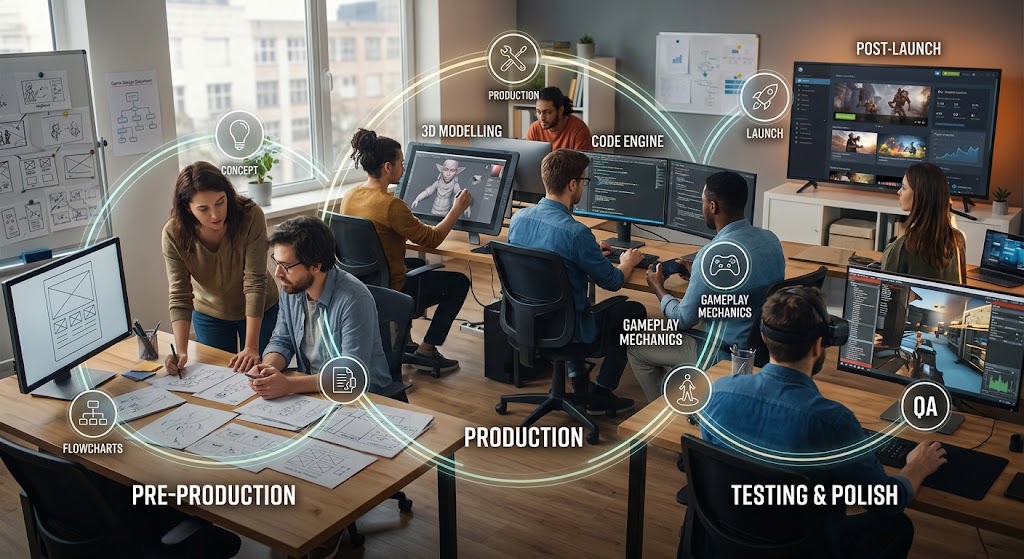
The journey of building a video game spans three major phases: pre-production, production, and post-production. Each phase serves a specific purpose, and skipping steps usually leads to technical bugs, missed release dates, or budget overruns.
Pre-production sets the foundation. This is where designers write the Game Design Document (GDD), create initial concept art, and build quick prototypes. Production is where the heavy lifting happens. Artists create 3D models and environments, while programmers write engine code and construct game mechanics. Post-production handles final testing, market distribution, and ongoing live operations after launch.
| Development Phase | Primary Goal | Key Deliverables |
|---|---|---|
| Pre-Production | Concept validation & design setup | GDD, concept art, playable prototype |
| Production | Asset creation & coding | 3D models, sound tracks, core code, UI/UX |
| Post-Production | Polishing, launch, maintenance | QA reports, platform builds, patches, DLC |
Full cycle game development relies heavily on seamless coordination across these three phases. If a design flaw is caught during pre-production, fixing it costs very little. If that same flaw reaches full production, fixing it requires rewriting code and re-designing assets, which drains valuable time and capital.
Teams that practice full cycle game development focus on early risk mitigation. They test mechanics in grey-box environments before art is applied. This ensures the game is actually fun to play before millions of dollars are invested in visual fidelity.
Pre-Production: Planning for Full Cycle Game Development
Before writing a line of final code, you need a blueprint. Pre-production is where your game idea meets reality. During this stage, small teams work together to answer fundamental questions. What is the game about? Who is the target player? What technology will power the experience?
The centerpiece of pre-production is the Game Design Document. This living document outlines gameplay mechanics, story arcs, character designs, level layouts, and audio design principles. It keeps everyone on the team aligned, preventing creative direction from drifting over months of production.
Prototyping is another essential activity. Programmers build rough, untextured levels using basic shapes like cubes and spheres. The goal here is simple: test if the core gameplay loop feels rewarding. If jumping, shooting, or puzzle-solving feels awkward in a grey box, fancy graphics will not save it later.
- Defining target audience, monetization strategy, and platform availability.
- Drafting detailed Game Design Documents and visual style guides.
- Building rapid interactive prototypes to prove core gameplay mechanics.
- Selecting game engines, development tools, and project management pipelines.
Full cycle game development requires setting realistic scope limits right here. Feature creep-the tendency to keep adding new ideas during production-is the primary reason projects fall behind schedule. A tight, well-scoped pre-production phase establishes clear boundaries that protect your schedule and budget.
Main Production: Executing Full Cycle Game Development
Production is the longest and most resource-intensive stage of full cycle game development. This is where art, code, audio, and narrative merge into a playable build. Large teams of artists, animators, software engineers, sound engineers, and level designers work in parallel to build every asset and system.
Programmers construct game physics, artificial intelligence, user interface logic, save systems, and network code for multiplayer titles. Simultaneously, 3D artists model characters, paint textures, setup rigging, and animate movements. Sound designers record ambient effects, voiceover dialogue, and compose background music to match the emotional tone of each level.
Integration is where the magic happens. All visual and audio elements are imported into the chosen game engine-such as Unreal Engine, Unity, or a custom proprietary tool. Level designers take these assets and construct actual game environments, placing enemies, triggers, hazards, and collectibles across the map.
- Building 3D character models, environment assets, and visual effects.
- Writing clean, performant source code for core mechanics and systems.
- Designing immersive audio, voice tracks, and adaptive musical scores.
- Integrating assets into the engine and crafting interactive level layouts.
Throughout production, team leads hold regular standup meetings and track progress through milestone builds. Common internal milestones include the Vertical Slice (a fully polished, short segment of the game), Alpha (all features present but buggy), and Beta (all content complete, focus shifts to bug fixing).
Adopting full cycle game development principles ensures that production flows logically from milestone to milestone. Rather than building random features, teams focus on completing specific functional vertical slices. This approach keeps stakeholders informed and makes progress measurable.
Post-Launch Maintenance and Quality Assurance
Once a game hits its Beta stage, the focus shifts sharply to Quality Assurance (QA). Testers play through every level hundreds of times, deliberately trying to break the game. They actively look for collision glitches, memory leaks, progression blockers, and balance issues.
QA is not just about finding bugs; it is about refining user experience. Testers provide feedback on difficulty curves, controls responsiveness, and menu clarity. Bug tracking databases, like Jira, log every issue so programmers can systematically fix them before launch day.
The release day is no longer the end of the project. In modern gaming, post-launch support is a crucial pillar of full cycle game development. Players expect immediate Day-One patches, stability fixes, and long-term content updates. Live-ops teams monitor server health, analyze player behavior, and introduce fresh events, seasons, or DLC expansion packs to keep the community engaged over time.
Comparing Development Approaches
Not every studio manages full cycle game development the same way. Some hire an internal team for every discipline, while others partner with external development agencies to handle co-development or specialized tasks like 3D art production and QA testing.
Here is how in-house development compares to full-cycle outsourcing partnerships:
| Comparison Factor | In-House Development | Full Cycle Outsourcing |
|---|---|---|
| Management Control | Direct daily oversight | Milestone and output based |
| Setup Speed | Requires lengthy hiring process | Immediate access to established teams |
| Scalability | Fixed internal capacity | Flexible team scaling on demand |
| Cost Structure | Fixed overhead and salaries | Predictable project-based pricing |
Both models have merits. Smaller studios often lean on external full cycle game development teams to access specialized technical skill sets without increasing permanent headcounts. Larger publishers frequently mix both approaches, keeping core design in-house while working with external partners for art assets, porting, and quality testing.
Choosing the Right Game Engine for Your Project
A crucial choice in full cycle game development is picking your core game engine. The engine handles rendering, physics, audio playback, memory management, and input logic. Your decision affects hiring needs, art workflows, and target platform compatibility.
Unity and Unreal Engine dominate the modern landscape. Unity is celebrated for its flexibility, lightweight architecture, and strong support for 2D and mobile gaming. Unreal Engine is renowned for photorealistic high-end visuals, built-in visual scripting via Blueprints, and powerful 3D tools designed for PC and console titles.
- Evaluate target platforms: mobile, PC, console, or web browsers.
- Assess team expertise in C# (Unity) vs. C++ and Blueprints (Unreal).
- Consider licensing structures, royalty fees, and open-source alternatives.
- Examine ecosystem assets, community documentation, and third-party plugin support.
Choosing the wrong engine early on leads to costly migrations midway through production. Take time during pre-production to test your technical scope against engine capabilities. Full cycle game development success depends heavily on choosing technology that aligns directly with your visual ambition and performance goals.
Frequently Asked Questions
What Is Full Cycle Game Development?
Full cycle game development encompasses the complete process of creating a video game from start to finish. It includes pre-production planning, game design, art asset creation, programming, audio integration, quality assurance testing, platform distribution, and post-launch updates.
How Long Does Full Cycle Game Development Take?
The timeline depends heavily on the project’s complexity and scope. A simple mobile game can take between 3 to 9 months, while a mid-tier indie game usually takes 1 to 2 years. Complex AAA titles for console and PC routinely take 3 to 5 years or longer to finish.
What Roles Are Required in a Full Cycle Team?
A standard full cycle team includes game designers, producers, programmers, 2D and 3D artists, animators, sound engineers, narrative writers, and quality assurance testers. On larger projects, specialized roles like UI/UX designers, backend server engineers, and live-ops managers are also essential.
How Much Does Full Cycle Game Development Cost?
Costs vary widely based on team location, scope, and target platforms. Small mobile games might cost between $20,000 and $100,000. Mid-sized indie titles range from $200,000 to over $1,000,000, while high-end PC and console games routinely exceed tens of millions of dollars in total budget.
Why Is Pre-Production So Important in Game Development?
Pre-production identifies creative and technical risks before major production capital is spent. By building prototypes and writing detailed design documentation early, development teams avoid scope creep, reduce costly redesigns, and establish realistic schedules and budgets.
What Is the Difference Between Alpha and Beta Stages?
The Alpha stage means all planned core features are implemented, but content may be incomplete and bugs remain. The Beta stage means all game content is fully present, feature sets are frozen, and the team focuses exclusively on bug fixing, performance optimization, and player feedback polish.
Can You Outsource Full Cycle Game Development?
Yes, many publishers and intellectual property owners outsource full cycle game development to specialized development studios. The client provides the initial concept or IP, while the partner studio handles all planning, production, testing, and delivery under a single structured contract.
Final Thoughts on Game Development
Bringing a video game to market requires balancing art, technology, project management, and business strategy. Following a structured full cycle game development workflow gives your team a clear roadmap from day one. It reduces unexpected risks, keeps development costs manageable, and gives your project the best chance to stand out in a competitive market. Focus on early prototyping, maintain strict scope discipline, and treat testing as a continuous priority throughout the journey.
Leave a Reply