



How a Gaming Development Company Brings Ideas to Life
Making a great video game takes far more than just a fun idea written down in a notebook. It requires a dedicated team, technical expertise, artistic vision, and a deep understanding of what players actually enjoy when they pick up a controller or launch an app.
Working with a professional gaming development company helps creators turn raw concepts into polished, playable products. Whether you want to build a simple mobile puzzle game or an expansive multiplayer online world, the right studio makes all the difference in turning that vision into reality.
In this comprehensive guide, we will break down what a gaming development company actually does, how projects move from initial concept to public release, how budgets are structured, and what you need to consider before signing a contract.
What Does a Gaming Development Company Do?
A gaming development company handles the complete process of building a video game from the ground up. They take care of software engineering, level design, artistic asset creation, audio engineering, UI design, and quality assurance testing.
Some studios focus on specific platforms like iOS, Android, PC, or modern consoles like PlayStation and Xbox. Others specialize in specific game engines like Unity, Unreal Engine, or custom proprietary technology. Depending on your project scope, you might hire a full-service team or a specialized studio for co-development work.
So, why not just build everything in-house from scratch? Building an internal development team takes months of recruiting, expensive onboarding, and high ongoing overhead costs. Partnering with an established gaming development company lets you skip the hiring headaches and tap into battle-tested talent right away.
Here is what a full-service team usually brings to your project:
- Game Designers who shape core gameplay mechanics, progression systems, level layouts, and narrative pacing.
- Software Engineers who write clean code, build backend server architecture, and fine-tune performance across devices.
- 2D and 3D Artists who design characters, environments, animations, particle effects, and user interface elements.
- Quality Assurance Testers who systematically find bugs, test mechanics under stress, and ensure smooth performance.
- Project Managers and Producers who keep production schedules on track and manage resources effectively.
Key Services Provided by a Gaming Development Company
Not every project requires a brand-new game built completely from scratch. Many studios offer flexible service models tailored to where you are in your production lifecycle.
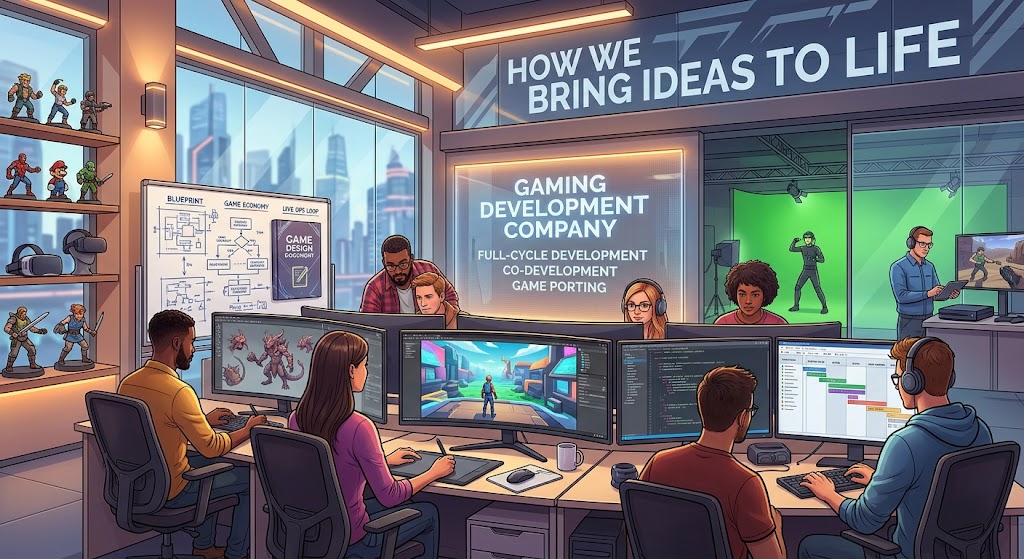
Full-cycle development means the studio manages everything from early ideation and concept art all the way to post-launch updates. Co-development, on the other hand, means external engineers and artists join your existing team to speed up production or tackle complex technical features that your team lacks experience in.
Game porting is another essential service. If you have a successful PC game and want to expand to Nintendo Switch, PlayStation, or mobile devices, a gaming development company can rewrite underlying platform systems and re-adapt graphics assets to run smoothly on target hardware.
| Service Type | Primary Focus | Ideal For |
|---|---|---|
| Full-Cycle Development | End-to-end game creation from original concept to live operations. | Clients with an idea but no internal production team. |
| Co-Development | Adding specialized talent to expand an existing dev team. | Studios needing extra engineering or art capacity quickly. |
| Game Porting | Adapting an existing title to run on different platforms. | Developers expanding their player base to consoles or mobile. |
| Game Modernization | Updating legacy code, visual assets, and UI for modern devices. | IP owners looking to remaster classic titles for new audiences. |
Choosing the right engagement model depends entirely on your budget, team size, timeline, and internal technical knowledge. Take time to evaluate what skills your core team lacks before starting discussions with potential partners.
Understanding the Stages of Game Production
Every successful title passes through distinct, structured phases. Skipping steps almost always leads to bloated budgets, missed deadlines, or buggy releases, so professional teams stick to organized production pipelines.
Pre-Production: Laying the Foundation
Before writing a single line of code or modeling 3D assets, the team defines the core gameplay mechanics, target audience, art style, and revenue strategy. They write a Game Design Document (GDD) that serves as the central blueprint for the entire project team.
Prototyping happens during this early phase as well. Developers build simple gray-box versions of core gameplay mechanics to test whether the game loop is actually fun and satisfying to play.
If the prototype feels boring or clunky, the design is revised immediately. Catching design flaws during pre-production saves tens of thousands of dollars compared to fixing them late in development.
Production: Building the Core Experience
Once the blueprint and prototypes are approved, full production begins in earnest. Artists start creating high-resolution assets, sound designers record audio effects, and software engineers connect all mechanics into a coherent framework.
This phase is usually the longest and most expensive part of the journey. Production is broken down into small milestones, often managed with agile frameworks like Scrum or Kanban to maintain momentum.
Regular milestone reviews keep everyone on the same page. You will see functional builds every few weeks, allowing you to provide feedback as features come together bit by bit.
Common milestones during game production include:
- Vertical Slice: A fully polished, playable single level demonstrating final visual, audio, and gameplay quality.
- Alpha State: All gameplay systems and core features are functional, though bugs and placeholder assets may remain.
- Beta State: All content is complete with no critical bugs, focusing heavily on playtesting, balancing, and polish.
- Gold Master: The final, stable build submitted to digital store platforms and console certification boards.
Post-Production: Launch and Live Operations
Launching the game on app stores or steam is not the end of the road. Modern games, especially free-to-play mobile games and online multiplayer titles, require continuous updates, seasonal events, and technical monitoring.
A reliable gaming development company helps monitor live server metrics, fix unexpected crash bugs reported by real players, and balance game economy systems to keep player retention high over long periods.
| Production Phase | Key Deliverables | Main Objective |
|---|---|---|
| Pre-Production | Game Design Document, playable prototype, visual target art. | Validate game mechanics and establish production roadmap. |
| Production | 3D models, code base, levels, audio tracks, user interface. | Construct all game systems and assemble complete builds. |
| Quality Assurance | Bug reports, stress test logs, platform compliance checks. | Ensure stability, balance, and compliance with platform standards. |
| Live Operations | Content patches, event updates, server maintenance, hotfixes. | Retain active players and drive long-term engagement. |
Maintaining a live game requires consistent attention and fast reaction times. Having a reliable production partner for live operations ensures your community stays engaged and happy for years after launch.
How to Select the Best Gaming Development Company
Finding the right development partner is one of the most critical decisions you will make. With thousands of development studios operating worldwide, narrowing down your choices can feel overwhelming at first.
Look at these critical factors when evaluating potential development partners:
- Portfolio Quality: Review their published titles carefully. Have they successfully delivered games similar in scope and art style to your project?
- Technical Expertise: Ensure their team has hands-on experience with your chosen engine, whether Unity, Unreal Engine, or custom backend tech.
- Communication Culture: Ask about their reporting frequency, collaboration tools, video meeting schedules, and project management transparency.
- Client References: Reach out to former clients to ask about deadline reliability, code quality, and how the studio handles unexpected technical challenges.
Pay close attention to how open and honest the studio is during initial consultations. A trustworthy gaming development company will offer realistic time estimates and honest feedback on your scope rather than making grand promises they cannot keep.
Avoid picking a studio solely based on the absolute lowest price quote. Unusually low quotes often result in hidden fees, missed deadlines, poor code structure, or complete project restarts later on.
Here is how the onboarding process usually works: you share your concept under a Non-Disclosure Agreement (NDA), discuss requirements in detail, receive a comprehensive scope proposal, and then finalize contract terms and payment schedules.
Evaluating Costs and Budgeting for Game Projects
Budgeting for game development requires understanding where money actually goes during production. Labor costs make up the largest share of any game budget, as specialized engineers, 3D artists, and game designers require competitive compensation.
Small casual mobile titles built with modest graphics can cost anywhere from $25,000 to $75,000 depending on scope. Mid-tier indie titles for PC or consoles with custom art, detailed levels, and multiplayer features usually range from $150,000 to over $500,000.
Large-scale projects with realistic graphics, custom physics, extensive narrative branching, and cloud backend networks can easily run into several million dollars. Understanding these baseline realities helps you set achievable expectations before starting development.
It is also wise to set aside a contingency fund of roughly 15% to 20% of your total budget. Unexpected technical roadblocks, platform certification adjustments, and gameplay tweaks always arise during production, so having financial buffer keeps the project moving smoothly.
Marketing and platform distribution costs should also be factored into your overall business plan. Creating a great game is only half the battle; ensuring players actually discover and download your title requires dedicated user acquisition and community building efforts.
Frequently Asked Questions
What Is a Gaming Development Company?
A gaming development company is a specialized organization made up of software engineers, artists, game designers, sound engineers, QA testers, and project managers who collaborate to create interactive video games for various gaming platforms.
How Much Does It Cost to Hire a Gaming Development Company?
Costs range widely from $20,000 for simple 2D mobile titles to over $1,000,000 for high-end 3D games across PC and consoles. The final price depends on game complexity, visual style, engine choice, and total development hours required.
How Long Does Game Development Take?
A straightforward mobile or casual title can take three to six months to complete. A feature-rich PC or console game usually requires anywhere from 12 to 36 months of continuous development work from concept to store release.
Which Game Engine Should My Project Use?
Unity is ideal for 2D games, mobile titles, and cross-platform projects. Unreal Engine is the standard for high-end 3D visual quality and console games. Your development team will recommend the best engine based on your technical needs.
Do I Keep the Intellectual Property Rights?
Yes, standard development contracts state that all intellectual property rights, source code, game assets, and design files are transferred to you upon full payment. Always confirm IP ownership clauses before signing any agreements.
What Information Do I Need Before Contacting a Studio?
You should prepare a document outlining your game concept, target platform, main gameplay mechanics, visual references, target audience, budget range, and desired target release date.
Can a Studio Help Update an Existing Game?
Yes, many studios offer specialized co-development, porting, code refactoring, performance optimization, and live ops management services to help update, expand, or maintain existing active games.
Building a successful video game requires clear vision, methodical planning, and expert technical execution. Partnering with an experienced gaming development company provides your project with the structure, talent, and quality focus needed to succeed in today’s competitive gaming marketplace. Focus on defining your core goals clearly, select a production partner with a proven track record, and maintain active, open communication through every stage of production.
Leave a Reply