



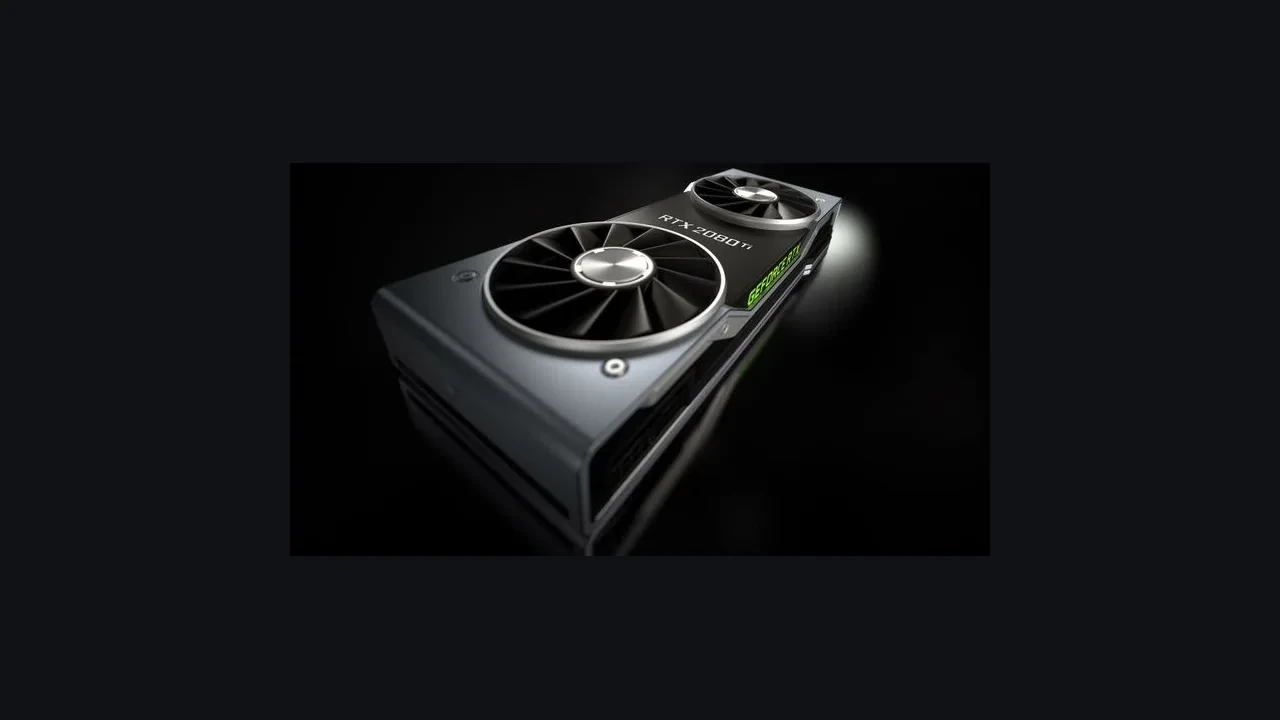

GeForce RTX 2080 DLSS 5 compatibility: where the desktop RTX 20 series sits
NVIDIA has announced no official DLSS 5 launch support for the desktop GeForce RTX 2080, and its future status is not public. The RTX 20 series currently supports DLSS 4.5 Super Resolution and Ray Reconstruction.
That is the version studios should use in quarterly build decisions, even though QA benches, indie teams, and players still rely on the card eight years after release.
The support boundary affects engine behavior, verification, and customer communication. None of those should depend on a prediction that NVIDIA may add the card later.
This discussion covers the desktop GeForce RTX 2080, including Founders Edition and partner boards with the same TU104 silicon profile. Laptop and Max-Q models, the RTX 2080 Super, Ti versions, the D6 refresh, and other RTX 20 products need separate checks.
Desktop GeForce RTX 2080 specifications
NVIDIA launched the TU104-based RTX 2080 in September 2018 as one of the first consumer GPUs with hardware ray tracing and dedicated Tensor Cores. The desktop card has 8 GB of GDDR6 on a 256-bit bus, 2944 CUDA cores, and 368 Tensor Cores.
It still receives Game Ready and Studio updates on the long-lived RTX 20 driver branch, which keeps it in production compatibility tables.
DLSS is a stack of Tensor Core runtime modules, a driver integration layer, and an engine plugin called through the published SDK. Each generation has minimum compute and memory requirements. The RTX 2080 combines functional Tensor hardware, 8 GB of VRAM, and an active driver line, putting it inside DLSS 4.5 support but outside the announced DLSS 5 list.
How earlier DLSS branches treated old GPUs
Each DLSS sub-feature has its own requirements. The release history gives a useful guide, although it cannot confirm DLSS 5 support by itself.
- DLSS 1.0 and 1.9 ran broadly on Tensor Core hardware, including desktop RTX 20 cards, though early games showed visible quality compromises.
- DLSS 2.x moved to a temporal upscaler and kept broad RTX 20 support as the SDK matured. It became the long-running baseline for that driver branch.
- DLSS 3 Frame Generation introduced a hardware cutoff. It needs the Optical Flow Accelerator found in Ada Lovelace RTX 40 cards and newer GPUs, so RTX 20 cards retained Super Resolution without gaining Frame Generation.
- DLSS 3.5 Ray Reconstruction reached older RTX hardware because it uses the Tensor path already needed by Super Resolution.
- DLSS 4 and Multi Frame Generation focused on RTX 50 cards, with new transformer-based model classes appearing first on the newest silicon.
Super Resolution and Ray Reconstruction have generally reached older RTX generations when their Tensor path was suitable. Frame interpolation and new neural-model classes have stayed on newer silicon. NVIDIA makes each cutoff separately through its product page, SDK notes, and accompanying research communication.
The RTX 20 series support line today
DLSS 4.5 is the current official branch for the desktop RTX 2080.
It provides DLSS 4.5 Super Resolution as the upscaler and DLSS 4.5 Ray Reconstruction as the denoiser through the standard NVIDIA driver.
When a game advertises “DLSS supported” on this GPU, it is referring to that 4.5 family. NVIDIA has tested and published this runtime path for RTX 20 hardware.
DLSS 5 is framed as a new class of neural rendering aimed at current GPUs rather than a routine update to 4.5. The RTX 2080 sits outside the published launch list, which should control any production commitment.
What no official support means for a shipping game
NVIDIA has not named the RTX 2080 as a DLSS 5 target, placed it in the compatibility matrix, or published validated driver behavior for the SKU. That does not prove the silicon could never execute any DLSS 5 code. It does mean a studio cannot support the path today.
- Keep DLSS 5 out of the desktop RTX 2080 QA scope and continue validating DLSS 4.5.
- Mark the card as “not officially supported” in DLSS 5 marketing tables rather than leaving an ambiguous blank.
- Tell players that Super Resolution and Ray Reconstruction remain supported through DLSS 4.5.
- The engine may contain DLSS 5 code, but it must detect the GPU and fall back to 4.5 when the runtime rejects the newer path.
This does not require rebuilding the renderer. It does require deliberate menu text and a public compatibility table that match the runtime.
DLSS feature support on the RTX 2080
In 2026, the RTX 2080 is a 2018 desktop GPU with working Tensor Cores, an active driver line, and a shared position in the RTX 20 series family. That reference documents the mobile range, SUPER refresh, board designs, silicon variants, and launch window.
The table keeps to the public support state and leaves future eligibility unresolved.
| DLSS feature | Generation role | Desktop RTX 2080 status | Typical developer impact |
|---|---|---|---|
| DLSS 4.5 Super Resolution | Upscaler | Officially supported | Stable runtime, available in current NVIDIA branch driver |
| DLSS 4.5 Ray Reconstruction | Denoiser | Officially supported | Exposed to the engine through the same SDK path as Super Resolution |
| DLSS 3 Frame Generation | Frame interpolation | Not supported | Requires the Optical Flow Accelerator on RTX 40 and later |
| DLSS 4 Multi Frame Generation | Multi-frame interpolation | Not supported | Targets RTX 50 series; not in the RTX 20 compatibility matrix |
| DLSS 5 | New neural rendering generation | No official support announced | Compatibility boundary is not published for RTX 20 at launch |
Do not infer the RTX 2080’s status from a neighboring GPU. Ship against its supported line and revisit the row when NVIDIA publishes an update.
How an engine identifies available features
Engines ask the NVIDIA runtime for a capability ID, driver version, and application profile rather than checking a marketing name string.
- The engine initializes NGX through the driver. An old driver causes the call to fail and reports DLSS unavailable on any GPU.
- It queries the device generation and compute capability. The desktop RTX 2080 reports Turing, 8 GB of GDDR6, and a TU104 identifier.
- It requests the available DLSS paths. The card returns DLSS 4.5 Super Resolution and Ray Reconstruction.
- It asks for DLSS 5. During the current launch window, the answer is no because NVIDIA has not announced RTX 20 support.
- The engine uses the highest available path, which is a stable DLSS 4.5 Quality, Balanced, or Performance preset.
This method survives GPU naming changes, but it still needs a current driver. Long-support games should publish a minimum driver version. Pinning an older release can make NGX reject a feature the card would otherwise run.
Pre-release checks for developers and technical artists
- Confirm the shipping driver’s feature list against NVIDIA’s published support list for the desktop RTX 2080.
- Run the engine capability probe on the card and production driver, then save the returned feature IDs in a log.
- Render representative scenes at the target resolution and quality preset, recording performance and image-quality baselines.
- Update the public matrix with the supported feature branch and an explicit DLSS 5 status for the card.
- Document the fallback so a later driver can expose a new feature without an engine code change and a runtime failure still returns players to a safe path.
The same verification loop applies to every DLSS branch. It should run on production drivers, not insider builds found on developer workstations.
What the status means for players
The desktop RTX 2080 is outside the official DLSS 5 launch list, with no public promise of a later backport.
It is not obsolete. Most current DLSS games can still expose DLSS 4.5 Super Resolution and Ray Reconstruction on the card.
If DLSS 4.5 already meets the player’s target, waiting for an unannounced update gains nothing. An upgrade decision should instead ask whether desired games use the new feature, how much their image quality changes at an equal internal resolution, and whether newer hardware is needed for the target frame rate.
How to communicate the boundary
- Publish a per-GPU table with the desktop RTX 2080 on DLSS 4.5 and an explicit “DLSS 5: not officially supported” note.
- Attach the engine and minimum-driver versions so players can reproduce the result.
- State the current position without promising future support, while acknowledging that NVIDIA may revise it.
- Update the table after a support-list change because driver branches can alter exposure on the long-lived RTX 20 platform.
Clear versioning also reduces tickets from players asking for a runtime path their GPU cannot expose.
If NVIDIA later adds RTX 20 support
The official DLSS 5 communication does not rule out a later change. If NVIDIA adds the RTX 2080, the support row moves from DLSS 4.5 to DLSS 5 and the existing NGX probe exposes the new path. QA then repeats its scene matrix for image quality and performance, and public documentation follows the result.
No renderer redesign should be needed. Keeping DLSS 5 code compiled but gated by the capability query lets a future driver enable it without a game patch. The remaining work is verification and accurate communication.
The RTX 2080 in a multi-generation PC matrix
Most AA and AAA games support several generations because publishers need a wide installed base. The RTX 2080 often becomes the old-but-supported row against which the rest of the table is organized.
| Generation band | Example desktop SKUs | DLSS feature branch in 2026 | Role in the matrix |
|---|---|---|---|
| RTX 50 series | RTX 5090, 5080, 5070 Ti, 5070 | DLSS 5 lead target | Showcase tier for new features |
| RTX 40 series | RTX 4090, 4080, 4070 Ti, 4070 | DLSS 5 supported tier with full feature set | Mainstream premium tier |
| RTX 30 series | RTX 3090, 3080, 3070, 3060 Ti | DLSS 4.5 with selected DLSS 5 paths as announced | Performance tier |
| RTX 20 series | GeForce RTX 2080, 2070, 2060 | DLSS 4.5 (Super Resolution and Ray Reconstruction) | Legacy and install-base tier |
This 2026 matrix is a planning aid, not a guarantee. Recheck NVIDIA’s list with every driver update. The desktop RTX 2080 remains the DLSS 4.5 legacy row until NVIDIA publishes another answer.
Recommendations for studios and producers
- Keep DLSS 4.5 Super Resolution and Ray Reconstruction as the supported branch for the desktop RTX 2080. Do not advertise DLSS 5 on it.
- Run and log the NGX capability probe on the production driver before every release.
- Mark DLSS 5 as “not officially supported” rather than leaving a blank that readers may interpret as yes.
- Test the explicit DLSS 4.5 fallback so driver changes cannot leave the game in a broken state.
- Review the boundary whenever NVIDIA updates its list. A future driver branch is the most likely place for the answer to change.
Conservative wording costs one marketing bullet. An unsupported promise creates years of archived misinformation and avoidable support work.
Driver pinning for long support windows
A multi-year live-service game must choose a minimum NVIDIA driver branch for the RTX 2080. That choice directly controls which DLSS options players see.
NGX arrives through the NVIDIA driver, and every DLSS branch has a minimum version. A player below the minimum for the studio’s DLSS 4.5 build may see an older preset or native rendering. Publish that minimum beside the per-GPU feature list.
At the start of each release branch, set and document the driver floor. Raise it when the engine SDK changes. If NVIDIA later enables DLSS 5, this layer should only need a new minimum driver, since the engine probe already handles feature selection.
Edge cases behind real support tickets
- Rolling back a driver for another game can remove DLSS 4.5 visibility because NGX follows the installed version. Reinstall the published minimum or newer.
- Laptop and desktop reports are not interchangeable. The laptop RTX 2080 does not automatically share the desktop support row.
- A hybrid laptop may route an NGX call through integrated graphics instead of the discrete RTX adapter. Support needs to identify that setup before diagnosing the engine.
- Hand-tuned VRAM profiles on older RTX 2080 cards can break NGX initialization. Return to stock for the feature probe, then reapply the profile after the runtime starts.
These cases do not alter official compatibility, but they can change what a player sees. A documented driver floor and GPU row turns most of them into short support replies.
What to monitor next
Watch RTX 20 driver release notes, DLSS SDK notes, and NVIDIA Research updates around major milestones. Driver notes record field support changes, while SDK notes can alter engine requirements before a driver rollout becomes widespread.
Then run the capability probe on the production build. Its log is the only evidence tied to the exact binary and driver about to ship.
Frequently asked questions
Is the GeForce RTX 2080 officially supported by DLSS 5?
No. NVIDIA has announced no launch support for the desktop RTX 2080, and future eligibility is not public. DLSS 4.5 Super Resolution and Ray Reconstruction remain the supported RTX 20 features.
What DLSS features does the desktop RTX 2080 run today?
It runs DLSS 4.5 Super Resolution and Ray Reconstruction through the standard NGX runtime in engines using the official SDK and a current driver.
Could DLSS 5 be backported to the RTX 20 series in a later driver?
It is possible but unannounced. NVIDIA has historically extended Super Resolution and Ray Reconstruction where the Tensor path permits, while keeping Frame Generation and new model classes on newer silicon. Only an official announcement can settle DLSS 5.
Does DLSS 5 require hardware features that the RTX 2080 does not have?
NVIDIA’s public material targets its new neural features at current GPUs, but the exact prerequisite is set by each driver branch’s support list. Since the RTX 2080 is absent, any claim about the precise missing block remains a hypothesis.
Should my game advertise DLSS 5 support on the RTX 2080?
No. Advertise DLSS 4.5 and state that DLSS 5 is not officially supported. Do not make forward claims for hardware outside NVIDIA’s list.
Will DLSS Frame Generation ever come to the RTX 2080?
It is not expected. Frame Generation needs the Optical Flow Accelerator introduced with Ada Lovelace RTX 40 hardware, a block absent from the Turing-based RTX 2080. Super Resolution and Ray Reconstruction remain its supported paths.
Does the laptop RTX 2080 follow the same compatibility as the desktop card?
No. Laptop, Max-Q, RTX 2080 Super, Ti, D6 refresh, and other sibling products have separate behavior and require per-SKU verification.
What is the minimum NVIDIA driver version for DLSS 4.5 on the RTX 2080?
NVIDIA publishes the minimum beside each feature branch and device list. Studios should copy that value into their compatibility table. An older driver may cause NGX to report the feature unavailable.
Will the GeForce RTX 2080 keep getting DLSS 4.5 support going forward?
NVIDIA has continued to expose DLSS 4.5 Super Resolution and Ray Reconstruction on RTX 20 cards. Long-term access depends on the player’s driver branch, so studios should pin and publish a minimum version.
Where can I confirm the current GeForce RTX 2080 DLSS 5 compatibility status?
Cross-check NVIDIA’s DLSS 5 research and compatibility page, GeForce driver notes, and engine SDK documentation. Together they establish the supported feature list for the desktop card.
What should a studio do if a player insists their RTX 2080 is running DLSS 5?
Ask for the NVIDIA driver version and game build number, then compare both with the published list. A future driver may represent a real support change. Otherwise, the player probably misread an on-screen label, and the capability-probe output will show the active path.
Leave a Reply