



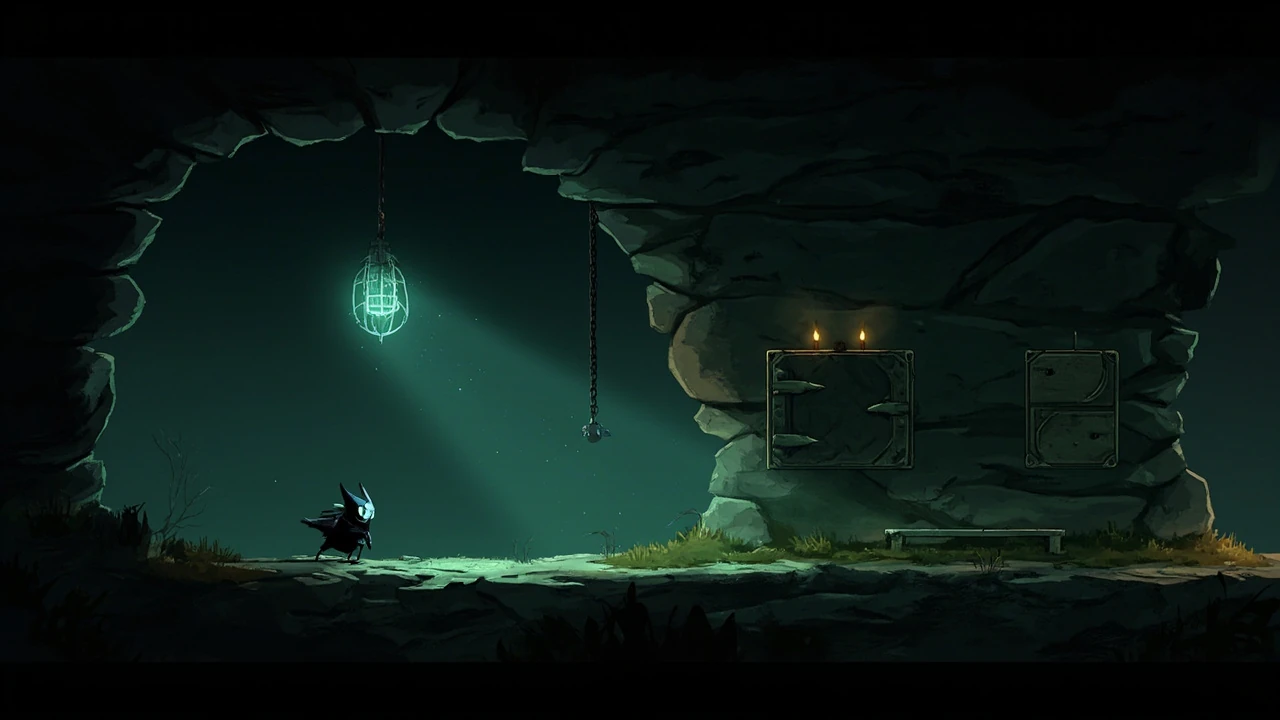

Sinners Road bench in Hollow Knight: Silksong, and why it refuses to work at first
The sinners road bench in Hollow Knight: Silksong looks like the first obvious save point in the area, and the moment a player approaches it the game still charges a toll. A bench that visibly exists but refuses to unlock has been a recurring irritant in Hollow Knight titles, so a quick recap of what this bench actually does, why it costs rosaries at all, and what unlocks the shortcut around it helps a lot before the route itself. The bench sits roughly in the middle of sinners road, near a central chamber that branches into several vertical paths, and reaching it from the halfway home involves a short elevator trip and a hallway filled with hostile dogs that patrol predictable lanes.
Most players find the bench on a first sweep through the area, hit the interaction prompt, pay the rosary fee, and then discover that the bench is still flagged as broken on the map. The fix is not on the bench itself, and it is not part of the bench room. A second, higher lever on a metal box controls a separate cage that creates the path back to the chamber, and that lever is the real trigger. This guide walks through the prerequisites, the exact route from the halfway home, the lever that matters, and the design lessons this kind of blocked save point teaches about metroidvania pacing.
Sinners road sits between two of the more memorable biomes in Silksong. It connects the calmer halfway home area to a longer stretch of vertical zones that fans tend to remember for their platforming pressure, and the bench acts as a soft seam between them. The dog patrols in the entrance hallway are loud on purpose, because the game wants the player to think about whether walking straight through is worth the risk or whether climbing the chamber first and returning through the cage is the calmer path. That small decision is the heart of the bench, and it shapes the rest of the run in ways that are easy to underestimate on a first visit.
What the sinners road bench actually is
The sinners road bench is a standard save point in Hollow Knight: Silksong with two details that make it stand out. First, the surrounding area is dense with combat, so the bench is positioned as a recovery node after a long stretch without one. Second, the bench is gated behind a small repair cost, which is presented as a one-time rosary fee when the player first interacts with it. Both of these details are typical for the wider bench system, but the sinners road bench goes further by also requiring a separate shortcut to make the room reliably reachable from the upper half of the map.
Save points in Silksong serve three jobs at once. They act as a fast travel target, they refill the player character’s health, and they create a soft checkpoint for the area. The sinners road bench is no different, but because the area itself loops vertically, finding the bench alone is not enough. Without the upper shortcut, the player is forced to replay the dog hallway each time, which contradicts the usual expectation that benches create safe loops. The two-part unlock, first the bench itself, then the cage, is what turns the room into a real anchor.
It is also worth noting how the bench relates to the surrounding pickups. The central chamber has a small cluster of rosary shards, a couple of simple charms, and a lore entry that is easy to miss if the player only runs the hallway and never climbs. The bench is placed so that a player who only runs the hallway can still find it, but a player who climbs the chamber can also use the bench as a base to sweep the rest of the room without committing to another full dog hallway run. The geometry of the area treats the bench as a midpoint, not a destination, which is a small but deliberate design choice.
Prerequisites before you try to fix the bench
Before walking into sinners road with the goal of fixing the bench, a small set of prerequisites makes the route much shorter. The area assumes the player has already crossed the halfway home bench, so the route starts from there, not from any earlier save point. Sinners road is also tuned around a small combat loadout, so light equipment is enough, but a ranged option helps with the dog encounters.
- At least 60 rosaries in inventory, ideally stored on a consumable string or a necklace so the fee is paid from a single item rather than the on-hand pool.
- The halfway home bench unlocked, since the route uses the local elevator as the entry point.
- Wall jump and a reliable mid-air recovery, because the jumping puzzle after the lever is the most common death source.
- Enough health or healing to survive at least two dog encounters in the long hallway, since the cages let you skip most of them but not all of them.
- Patience for one wrong turn, because the central chamber has several visually similar exits and one of them leads to a dead end with extra spikes.
The rosary count is the easiest prerequisite to forget. The bench still asks for payment even if the player has already spent the rosaries on other benches earlier in the run, so arriving at sinners road with the wrong amount forces a backtrack to a vendor or a farming loop. Storing rosaries on a string or necklace also keeps the fee from drawing down the regular pool, which matters later when the player wants to buy maps or simple charms.
Wall jump deserves a second look. The chamber has at least three distinct vertical climbs, and only one of them is the intended path toward the lever. A player who has been using simple jumps in earlier zones will find that wall jump changes the way the chamber reads, because several passages that look like decoration are actually climbable edges. The bench is designed for a player who already has wall jump, and a player without it will find the upper chamber frustratingly hard to reach even when they know the lever is there.
Route from the halfway home to the sinners road bench
The route from the halfway home to the sinners road bench has four distinct steps, and each step is short enough that the run can usually be completed in under five minutes once the path is known. A quick map of the sequence helps a lot, because the central chamber has several exits and only one of them leads toward the bench.
- From the halfway home bench, take the local elevator up into the area known as sinners road proper.
- Cross the rickety platforms that lead from the elevator into a long horizontal hallway patrolled by hostile dogs.
- Use the cages along the wall to skip most of the dog encounters, then continue into the central chamber at the end of the hallway.
- Resist the instinct to go right toward the visible bench, and instead wall jump upward into the side room that contains the lever.
The first two steps are the most forgiving. The elevator is a straight upward ride, and the rickety platforms are spaced so that a basic jump reaches the next one. The third step is where players lose the most time, because the dog patrols are long and the cages only cover a portion of the hallway. A patient player who watches one full patrol cycle can move through the hallway in a single run. The fourth step is the design decision that makes this bench unique, and it is worth slowing down at this point to look at the room before committing to a direction.
A useful habit during the third step is to count cages rather than dogs. The hallway has a known number of cage alcoves, and once the player has walked past the last one the central chamber entrance is one screen away. Counting cages turns the hallway from a tense stealth segment into a short, predictable walk, which is a small mental trick that saves real time on repeated runs. Players who try to time the dogs directly usually end up taking damage, because the patrol timings shift slightly between attempts.
Why the bench looks broken even after you pay
The single most common cause of confusion around the sinners road bench is the assumption that paying the rosary fee is the entire fix. After the fee is paid, the bench icon still appears dimmed on the in-game map, and the room itself does not gain a new exit, which is a strong signal that the bench is incomplete. The reason is that the developers of Silksong, following the wider metroidvania tradition of Hollow Knight, treat the bench fee as the cost of unlocking the save point itself, while the shortcut back to it is treated as a separate traversal unlock.
This split has a design reason. Bench fees create a small economic decision, where the player weighs paying the fee against saving the rosaries for a vendor. Shortcuts create a traversal decision, where the player weighs reaching the lever against a riskier exploration route. By separating the two, the area gets two distinct moments of choice instead of one, and the player who solves both moments in the right order gets a clean anchor for the rest of the run. The fee is necessary, but it is not sufficient.
There is also a quiet narrative reason. The bench is presented as damaged, not as locked, and the rosary fee is presented as a repair rather than a purchase. A repair implies that someone is fixing the bench, while the lever and the cage are the actual infrastructure work that makes the repair last. The split between fee and shortcut mirrors the split between the surface of the bench and the room around it, which is a small touch that the wider game repeats in several other zones.
The lever that actually unlocks the shortcut
The lever that actually unlocks the sinners road shortcut is not in the bench room. It sits higher up in the central chamber, attached to a metal box with spikes on its right side. The lever itself looks like a standard pull handle, but its position above the main floor means the player has to commit to climbing the chamber before the lever is reachable. Pulling the lever drops a cage on the opposite side of the chamber, which can then be ridden back down to the bench room.
The reason the lever is placed above the bench rather than next to it is to make the shortcut a deliberate choice. A lever at bench height would let any player who wandered in fix the area instantly, which would undermine the sense of progression that the rest of sinners road creates. By placing the lever high, the developers force the player to explore the upper half of the chamber, which in turn exposes several pickups, a small lore entry, and a side passage that leads to an optional encounter. Players who only want the bench pay the fee and leave, while players who want the area to feel like a real hub climb the chamber and earn the shortcut.
Two metal boxes sit on the upper level, both of them with spikes on their right sides. The first one is a red herring, because it is part of a wall segment that collapses if struck. The second one is the lever, and it is the one whose chain hangs far enough down to be reached from a wall jump. Looking at the chain length before committing to the pull saves a few seconds, because the wrong box forces a small backtrack to the central column.
Step by step: pulling the lever safely
Pulling the lever is a small puzzle, but it has a specific failure mode that is worth describing in detail. The metal box with spikes on its right side is the visual cue, and the cage it releases swings down on a fixed arc, so the player has to drop into the right position before pulling. The jump that follows the lever pull is the part where most players take damage, because the timing of the cage’s swing and the timing of the player’s drop have to align.
- From the central chamber, climb along the right wall until the metal box with spikes on its right side is visible above you.
- Drop down a short distance so the lever is in reach, but stop before the spike edge so the pull does not start a damage animation.
- Pull the lever, then immediately jump left into the cage as it swings down, so the cage catches the player instead of the spikes below.
- Ride the cage back to the bench room, then walk to the bench and sit down to confirm the save point is now active on the map.
The order of the last two steps matters. Pulling the lever and then trying to drop straight down into the bench room usually ends in a fall into the spike pit, because the cage does not stop at floor level, it stops above it. The intended path is to use the cage as a slow elevator, then jump from the cage at the moment it reaches the bench room’s height, not before. A common mistake is to jump too early and clip through the cage, which sends the player into the spike pit below.
A second mistake is to pull the lever while still holding the wall. The pull animation has a short recovery window, and holding the wall during it delays the jump that needs to follow. Letting go of the wall a frame before the pull, then jumping on the next frame, is the timing that the room is tuned around. Players who try to chain the pull and the jump in a single input usually miss the cage by a few pixels, which is just enough to send them into the spikes.
Why the cage shortcut is worth the extra effort
The cage shortcut is worth taking even if the player only cares about the bench, because the alternative is a long replay of the dog hallway every time the player dies. Without the cage, the bench still works as a save point, but the path back to it is so punishing that a single death during a later fight in the area will erase more progress than the bench saves. The cage cuts the return trip from a long hallway run to a short cage ride, which is the difference between a useful anchor and an unreliable one.
There is also a soft narrative reason to take the cage. The upper half of sinners road contains a small set of pickups that are easy to miss on a first pass, and the cage is the only way to reach them without going through the central chamber again. Players who skip the cage usually come back later to grab the pickups, which means they end up replaying the dog hallway anyway. Taking the cage on the first visit turns a single trip into a complete sweep, which is the kind of efficiency that matters more as the run progresses.
The cage also changes the geometry of the chamber in a way that helps with later fights. Several enemy spawns in the upper chamber are positioned around the cage’s resting position, and a player who has already used the cage once has a clearer picture of where the enemies will appear on a second visit. That familiarity adds up over the course of a run, and it is one of the reasons why players who fix the bench early tend to feel more comfortable in the rest of sinners road than players who fix it late.
What changes on the map after the bench is fully fixed
After both the fee and the cage shortcut are done, the sinners road bench shows up as a normal save point icon on the in-game map, with the same visual weight as every other bench. The change is small, but it has two effects. First, fast travel to the bench is now possible from any other unlocked bench, which makes the area a viable hub for adjacent zones. Second, the cage that the lever released is now part of the static geometry, so the player can use it to move between the upper and lower halves of the central chamber without relying on wall jumps.
For players who track their completion percentage, the bench fix is a small but real contribution. The map screen counts each functional bench as a discovered location, and the sinners road bench only counts once both conditions are met. Players who want a clean 100 percent map usually fix the bench before they leave the area, even if they have no plans to use it as a hub, because the icon otherwise sits as a permanent hole in the map screen.
There is also a small audio cue when the bench finally becomes a full save point. A short chime plays when the player sits on it for the first time after the cage is unlocked, and the same chime plays when the player fast travels to it. The chime is easy to miss, but it is a useful confirmation that the icon has updated and that the area is now treated as a real hub by the game’s internal map system.
Common mistakes that keep the bench from working
A small set of mistakes accounts for almost every report of a sinners road bench that refuses to work. The mistakes are easy to make because the area’s geometry encourages them, and the bench is forgiving enough that a partial fix looks like a complete one until the player tries to use it as a hub.
| Mistake | What it looks like | What the player should do instead |
|---|---|---|
| Paying the fee and leaving | Bench icon still dimmed, no shortcut back | Climb to the upper chamber and pull the lever on the spiked metal box |
| Jumping into the spike pit after pulling the lever | Player takes damage and respawns at the previous bench | Time the jump into the swinging cage, not into the floor below |
| Going right from the central chamber first | Player ends up in a dead end with extra spikes | Wall jump upward into the side room, not right toward the visible bench |
| Spending rosaries on other benches first | Player arrives with fewer than 60 rosaries and the fee fails | Store rosaries on a string or necklace before entering sinners road |
The table is a useful checklist, but the underlying lesson is the same. The sinners road bench is a two-part unlock, and treating it as a one-part unlock is what causes most of the frustration. A player who enters the area expecting two distinct fixes leaves with a working anchor, while a player who expects one fix usually leaves with a half-broken save point and a vague sense that the bench is glitched.
A fifth mistake that does not show up in the table is pulling the wrong lever. The chamber has two metal boxes with spikes on their right sides, and only the second one is wired to the cage. A player who pulls the first one triggers a short trap animation and then has to climb back up to try the second. The visual difference between the two boxes is small, and a careful look at the chain length is the fastest way to tell them apart.
How the sinners road bench compares to other early benches
The sinners road bench is not the first blocked bench in Hollow Knight: Silksong, and the pattern is worth comparing to similar saves in earlier areas. The Hunter’s March bench, which sits in an earlier zone, has a similar two-part unlock structure with a fee and a separate traversal step, while benches in later zones tend to unlock in a single interaction once the player has the right traversal tool. Sinners road sits in the middle of that range, which is consistent with its position in the overall progression.
| Bench area | Rosary fee | Shortcut required | Combat risk |
|---|---|---|---|
| Hunter’s March | Yes | Yes, lower platform | Moderate, ranged enemies |
| Sinners road | Yes | Yes, upper cage | High, dog patrols in hallway |
| Far fields early bench | No | No | Low |
| Late game hub bench | Yes | No, single lever | Low, defended by NPCs |
The pattern across the table is that the combination of a fee and a shortcut correlates with higher combat risk. Sinners road has both, which is consistent with its role as a mid-progression save point that gates several late game resources. Understanding the pattern helps the player anticipate the cost of any future blocked bench, which in turn shapes how the player manages their rosary pool.
It is also worth noting that the late game hub bench in the table is the only one that breaks the pattern. The hub bench has a fee but no shortcut, because it is placed in a defensible room that the player can return to without crossing a hostile hallway. The designers treat the hub as a destination rather than a midpoint, which is why the shortcut is dropped. Sinners road is a midpoint, and the cage is what makes the midpoint worth visiting more than once.
What this bench teaches about Silksong’s metroidvania design
The sinners road bench is a small case study in how Silksong uses save points as progression tools, not just recovery nodes. The fee creates a small economic moment, the lever creates a small traversal moment, and the cage ties the two together into a single loop that the player can trust. None of these elements are unique on their own, but the combination turns a routine save point into a small piece of level design that the player remembers.
For developers and technical learners, the bench is a useful example of how to gate a save point without frustrating the player. The fee is visible before the player commits, the lever is visible after the fee, and the cage is visible after the lever, so the player always knows what is left to do. A bench that hides any of these steps would feel arbitrary, while a bench that spells all of them out would feel mechanical. The sinners road bench sits in the middle, which is exactly the tone Silksong aims for across its level design.
For players, the bench is a useful reminder that a save point is a piece of the world, not just a button. The fee changes how the bench is read, the lever changes how the chamber is read, and the cage changes how the area is read as a whole. A run that fixes the bench on the first visit is a run that treats the area as a small system, while a run that fixes it on the second visit treats it as a checklist. Both runs finish the game, but the first run tends to feel cleaner, because the bench was never a question mark on the map.
How the bench fits into a wider sinners road run
The bench is one of three anchors that a typical sinners road run orbits around. The first anchor is the halfway home bench, which sets the tone for the area as a midpoint between calmer and louder biomes. The second anchor is the sinners road bench itself, which the player reaches after the elevator and the dog hallway. The third anchor is a small rest point in the upper chamber that the player only finds after the cage is unlocked, and that rest point is what makes the rest of the run feel manageable.
Players who treat the three anchors as a sequence usually find the run smooth. They start at the halfway home, push through the hallway with the cages, fix the sinners road bench, and then use the upper rest point as a base for the rest of the chamber. Players who treat the anchors as separate goals tend to bounce between them, which costs time and health. The bench is the pivot of the sequence, and the cage is what makes the pivot stable.
It is also worth thinking about when to fix the bench relative to other goals in the area. The bench fix is short enough that it can be done before the first real fight in the chamber, which is usually a good idea because the fight is harder to recover from without the bench. Players who leave the bench for after the fight tend to find that the fight has eaten more resources than expected, and the bench ends up being a recovery tool rather than a base. Fixing the bench first is a small habit that pays off across the rest of the area.
Frequently asked questions
Where is the sinners road bench located?
The sinners road bench sits in a side room off the central chamber of sinners road, reached by wall jumping upward from the chamber rather than by going right toward the visible bench prompt. The room is one short drop from the upper chamber where the lever is located, and the bench itself faces the cage that the lever eventually releases.
How many rosaries does the sinners road bench cost?
The sinners road bench costs 60 rosaries as a one-time repair fee, which is taken when the player first interacts with the bench. Storing rosaries on a consumable string or a necklace before entering the area is the cleanest way to pay, because the fee is then drawn from a single item rather than the on-hand pool that the player may need for vendors.
Why is the sinners road bench dimmed on the map after I pay?
The bench icon stays dimmed because paying the fee only unlocks the save point itself, not the shortcut back to it. The lever on the upper metal box is what creates the cage that returns to the bench room, and until that lever is pulled the bench is treated as a partial unlock. Both steps have to be completed before the icon turns into a normal save point.
Do I need the cage shortcut to use the bench as a save point?
No, the bench works as a save point after the fee is paid, and the player can sit on it and respawn at it. The cage shortcut is what makes the bench a reliable anchor for the area, because it removes the long replay of the dog hallway after each death. Without the cage, the bench still saves progress, but reaching it a second time is so slow that the save point loses much of its value.
Can I pull the lever before paying the bench fee?
Yes, the lever and the bench fee are independent. Pulling the lever first is a valid approach, and some players prefer it because the cage ride back to the bench room is faster than the hallway route. The order does not change the final state, so the choice comes down to whether the player wants to pay the fee as soon as they see the bench or wants to clear the upper chamber first.
What happens if I die during the cage jump?
If the player mistimes the cage jump after pulling the lever, they fall into the spike pit below and respawn at the last bench they sat on, which is usually the halfway home bench. The lever stays pulled, the cage stays in its lowered position, and the player can return to retry the jump without paying the bench fee again. The only resource lost on a failed jump is the health that was spent on the fall.
Is the sinners road bench required for any achievements or trophies?
The sinners road bench is a standard save point, so it does not unlock a standalone achievement on its own. It does contribute to the area completion percentage and the overall map completion counter, both of which feed into the broader completion rewards that Silksong tracks. Players who want full completion need to fully unlock the bench, which means paying the fee and pulling the lever.
What should I do before leaving sinners road for the first time?
Before leaving sinners road for the first time, the player should pay the bench fee, pull the lever, ride the cage back to the bench room, and confirm that the bench icon is now lit on the map. A short sweep of the upper chamber for pickups is also worth the time, because the cage is the only fast way to reach the upper chamber later. Once those steps are done, the area is a stable hub for the rest of the run.
Does the sinners road bench work in the same way in Hollow Knight: Silksong as in the original Hollow Knight?
No, the original Hollow Knight does not have a sinners road area, so the sinners road bench is unique to Silksong. Bench fees and shortcuts exist in both games, but the specific two-part unlock pattern at sinners road is a Silksong design choice that fits the new area’s combat and traversal demands. Players who come from the original game should treat the sinners road bench as a new mechanic, not a familiar one.
Where can I read more about the sinners road bench route?
For a walkthrough of the sinners road bench route and the lever shortcut, the Hollow Knight Silksong coverage at PC Gamer walks through the same hallway, the same central chamber, and the same upper lever that this guide describes, and it includes screenshots of the spiked metal box and the lowered cage. The article also notes the same caveat that the bench looks broken even after the fee, which is what usually sends players back to the upper chamber in the first place.
Leave a Reply